

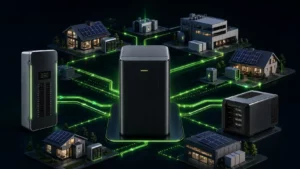
Your Solar Array Is Leaking Money at Noon — Here’s How to Fix It
California threw away 3.4 million megawatt-hours of solar energy in 2024. Meanwhile, AI data centers can’t find enough electricity to train their next model. The mismatch is one of the most valuable arbitrage opportunities in energy, and it’s hiding on your own roof.
The Most Expensive Two Hours of Your Day
Every sunny day, somewhere between noon and 3 p.m., your solar array does something the brochure never mentioned.
It stops producing power.
Not because a cloud rolled in. Not because a panel failed. Because your inverter, the piece of equipment sitting between your panels and your building, hits its rated AC output ceiling and throws a kill switch on every extra watt the panels were ready to deliver. The industry calls this “clipping”. The solar engineer calls it “a design choice.” The CFO (if the CFO ever sees it) calls it what it actually is: invisible financial loss.
Zoom out to the grid level and the same phenomenon runs at horror-movie scale. In 2024, the California Independent System Operator curtailed 3.4 million megawatt-hours of utility-scale wind and solar output, a 29% increase over 2023, according to the U.S. Energy Information Administration. Solar accounted for 93% of that waste. Through the first five months of 2025, 11.5% of California’s potential solar generation never made it onto the grid. On a single day in April 2025, CAISO curtailed 61,000 MWh, enough electricity to power roughly 2,000 American homes for a year, gone in 24 hours.
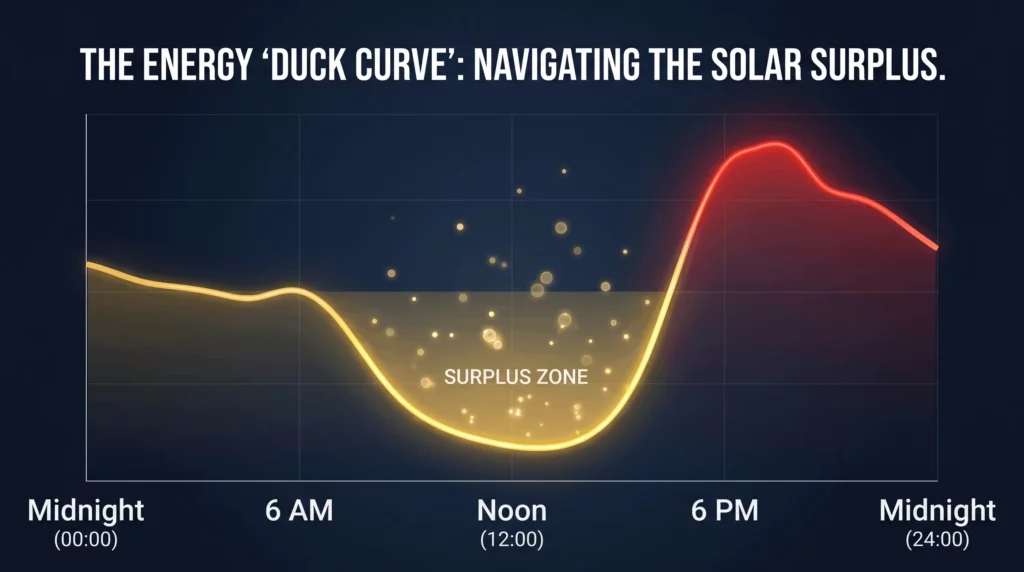
This is not a California problem. ERCOT curtailments are climbing in Texas as wind and solar capacity scale. The duck curve, the now-infamous midday net-load collapse that forces grid operators to waste renewable energy or pay generators to shut off, is getting deeper every quarter, not shallower.
And on a long enough time horizon, this same duck curve shows up at the facility level, for every commercial solar installation, in miniature. An oversized commercial array peaks at noon, overwhelms the inverter, feeds a building that’s only consuming a fraction of what the panels can produce, and quietly sheds the rest.
Why the “Fix” Everyone Sold You Doesn’t Actually Fix It
For the last decade, the solar industry’s answer to this problem has been a single word: batteries.
And to be fair, batteries help. Battery storage costs have dropped 93% from 2010 to 2024. California has deployed 77 utility-scale storage facilities since the start of 2024 alone. CAISO battery capacity jumped from 500 MW in 2020 to more than 13 GW by early 2025. Storage has measurably dented the curtailment numbers.
But here is what the “just add a battery” story leaves out:
A battery is not a revenue source. A battery is a timing arbitrage tool. It shifts energy from noon (when it’s cheap or free) to 7 p.m. (when it’s expensive), which is valuable, but only if your facility actually consumes that shifted energy, or you have a favorable net metering / export contract. For most commercial and industrial sites, the battery pays off the demand charge. It does not generate new income. And once the battery is full, which on a sunny day happens within hours, the inverter still clips. The surplus still vanishes.
This is the part of the economics nobody puts in the pitch deck: a battery only addresses a fraction of the clipped energy, and it does so by storing it for later self-consumption, not by turning it into cash.
Meanwhile, across the country, a completely different industry is having a completely different problem.
The Other Side of the Arbitrage: AI Is Starving for Electrons
PJM Interconnection’s most recent capacity auction cleared at the maximum allowable price, roughly 10x 2022 levels, driven almost entirely by data center demand. AEP Ohio has paused new data center interconnections. Virginia now consumes one in five kilowatt-hours its largest utility produces. Morgan Stanley forecasts a 49 GW U.S. power shortfall by 2028 from AI compute buildout alone.
The bottleneck is not GPUs. The bottleneck is electricity. Every serious AI operator, from hyperscalers down to regional GPU-as-a-service providers, is paying top dollar for any reliable source of kilowatt-hours they can plug an accelerator into. Compute-as-a-service providers are renting out inference and training capacity at rates that would have seemed absurd five years ago.
Put those two trends next to each other:
On one side | On the other side |
Solar operators are throwing away 11.5% of their generation | AI operators are paying premium prices for electrons |
Commercial rooftop arrays are clipping at noon | Compute workloads run 24/7 with flexible scheduling |
Batteries only shift energy; they don’t monetize it | GPUs convert energy directly into billable output |
This is not a coincidence. It is one of the cleanest arbitrage opportunities in the entire 2026 energy economy. The only question is: who builds the bridge between them?
The Diversion Load Controller: Turning Your Rooftop Into a Profit Center
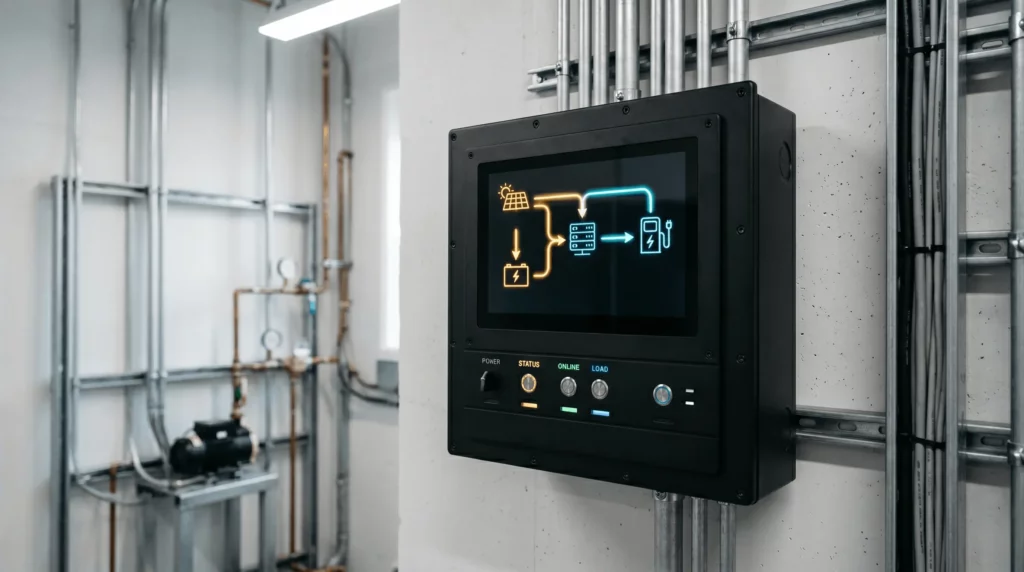
This is the architecture Intercal8 (a Cratus Technology brand) has engineered specifically for this moment: the Diversion Load Controller, Solar Compute Diversion Strategy.
The core idea is simple and, once you see it, almost obvious:
Instead of letting surplus solar energy clip at the inverter, divert it into a local workload that converts electricity directly into revenue, and keep that workload fed with stored energy overnight so it never stops earning.
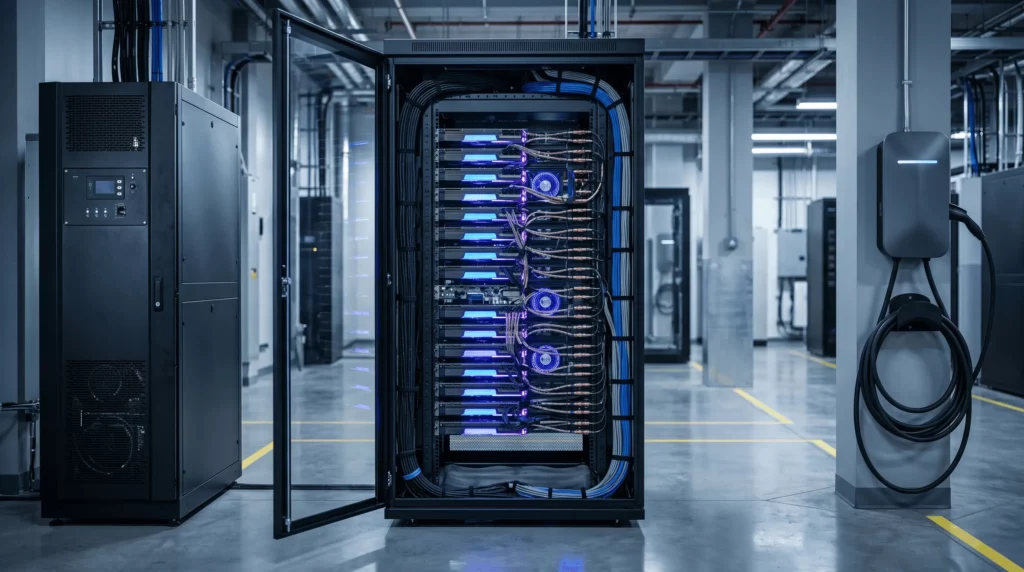
The workload, in Intercal8’s reference architecture, is a 42U Micro Datacenter (MDC), an industrial-grade compute rack tuned for AI inference, AI training, or other high-value compute contracts. It sits in your mechanical room, your shipping container, or your purpose-built enclosure, and it runs 24/7 on energy that would otherwise be thrown away during the day and purchased from the utility at a premium at night.
The Four Components That Make the Economics Work
- The Hybrid Core. The intelligent hub. Directs solar power, charges the batteries, manages the compute load, and arbitrates between every energy asset in real time. Without the Hybrid Core, you have a pile of expensive hardware. With it, you have a revenue engine.
- Dual-Asset Storage. A dedicated BESS (Battery Energy Storage System) plus a bidirectional EV charger acting as a secondary storage layer. The EV is no longer a one-way cost center sucking electricity out of your building, it becomes an active participant in keeping the compute cycle load monetized after dark. Vehicle-to-load, operationalized.
- The Strategically Oversized Solar Array. Counterintuitively, you want more DC capacity than your inverter can handle. Industry design convention already pushes DC/AC ratios to 1.2–1.5, and newer inverters support ratios up to 2.0. In a conventional system, that extra DC is clipped. In a Diversion Load Controller system, it is fuel for the compute rack. Over-provisioning flips from “acceptable engineering compromise” to “deliberate revenue strategy.”
4. The 42U Micro Datacenter. The “money maker.” An industrial-grade rack converting stored and surplus DC power into continuous, billable compute output. Purpose-designed for AI inference and training workloads, which are notably flexible about when they run, which is exactly what makes them the perfect match for an intermittent, surplus-driven energy profile.
Standard Solar + Storage vs. the Compute Diversion Strategy
The difference between a standard solar-plus-storage install and an Intercal8-architected Diversion Load Controller system is not a feature upgrade. It is a philosophical shift from “reduce my utility bill” to “turn my energy asset into a profit center”.
Dimension | Standard Solar + Storage | Compute Diversion Strategy |
Excess midday energy | Clipped / wasted | Monetized 24/7 via MDC |
Storage strategy | Backup only | Revenue preservation (overnight / overcast) |
EV integration | One-way charging only | Bidirectional storage feeding MDC |
Monitoring | Basic inverter data | Continuous monitoring of all flexible loads |
System intelligence | Simple load management | Predictive control & asset monetization |
Financial outcome | Reduced utility bill | Direct monthly revenue ($800–$1,000+) |
That last row is where the architecture stops being abstract. Intercal8’s reference ROI calculator for a modest commercial system, 20 kW solar array, 30 kWh BESS + EV storage, 5.5 daily sun-hours, projects roughly $850 per month in compute revenue. That is on top of the utility bill reduction the solar was already delivering.
A single mid-sized commercial rooftop. Roughly $10,000 per year in net-new revenue. From energy that, in the conventional architecture, quietly vanishes every day at noon.
Scale that to a distribution center, a manufacturing plant, or an industrial campus and the economics compound into genuine project-grade returns.
Why This Only Works If the Controller Is Actually Intelligent
Here’s the part of the pitch that deserves scrutiny, because a lot of vendors will try to sell you something that looks like this and isn’t.
Clipping energy into a “dumb” compute load a standalone crypto miner, a basic resistive heat dump, a space heater has existed for years. It works on paper. In practice, it fails because the energy profile is lumpy, the compute workload isn’t tuned to it, and the economics of the chosen workload (crypto especially) can change overnight.
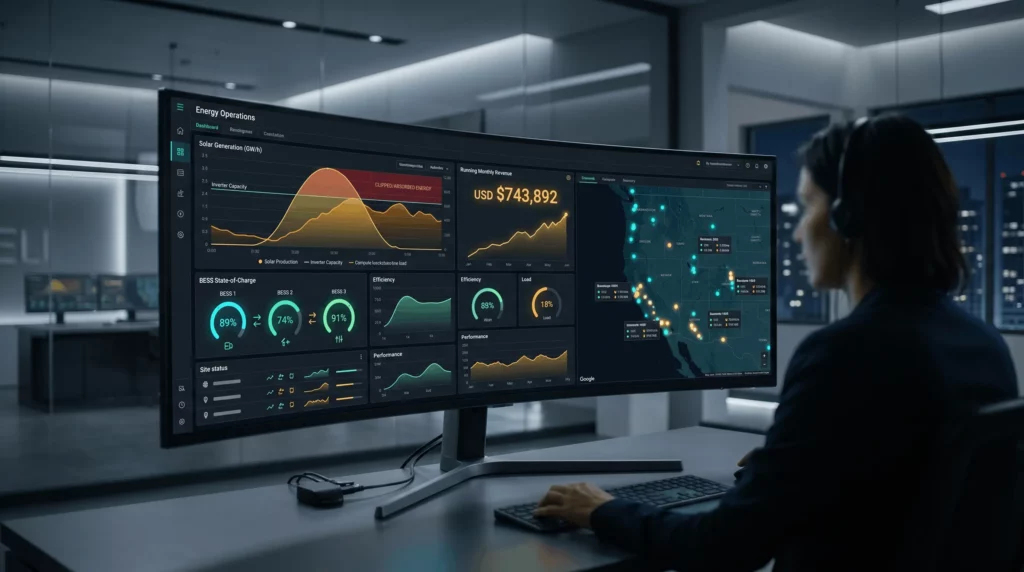
The Diversion Load Controller architecture works because the Hybrid Core is actively reasoning across every asset in real time:
- Predictively forecasting tomorrow’s solar surplus so the MDC workload scheduler can pre-commit to contracts.
- Deciding whether to charge the BESS, charge the EV, or feed the MDC directly based on current electricity prices, battery state-of-charge, and compute demand.
- Keeping the MDC running on cheap stored energy overnight so the revenue stream doesn’t stop when the sun sets.
- Protecting the building’s baseline loads, lights, HVAC, production equipment as the absolute first priority.
This is exactly the class of multi-asset optimization that the Intercal8 EMS platform is built for, and that its Microgrid Controls and Custom BMS layers make physically possible. Without an integrated intelligence layer on top of the hardware, the entire concept is a science project. With it, it is a financial instrument.
What This Changes About How You Think About Solar
If you take nothing else from this piece, take this:
Solar has spent the last fifteen years being pitched as a cost reduction tool. Pay less for electricity. Get off the grid. Hedge against utility rate increases. That framing was fine when the only option for surplus energy was to push it back onto a grid that increasingly doesn’t want it.
Solar is about to spend the next fifteen years being pitched as a revenue-generation tool. Produce cheap electrons. Convert them on-site into billable compute cycles. Collect the spread.
The winners in this transition will not be the companies with the biggest panels or the fanciest batteries. They will be the companies with the controller intelligence to coordinate solar, storage, bidirectional EV, and a monetizable on-site load into a single, predictable, revenue-producing system.
That is the entire thesis behind what Intercal8 is building.
Three Questions Worth Running the Numbers On This Quarter
- How much of your solar generation is actually clipping? If your installer hasn’t shown you a clipping analysis from your inverter data, ask for it. The answer is almost never zero, and on oversized commercial arrays it is frequently 3–10% of annual generation, a number that is pure upside in a Diversion Load Controller model.
- What is your midday-to-evening rate arbitrage? On a time-of-use tariff with a steep evening peak, every kWh you don’t export at noon and do use at 8 p.m. is worth more than the nameplate price of solar. Compute diversion captures both the arbitrage and the monetization.
- Do you already have a BESS or an EV on-site? If yes, you are most of the way to a Diversion Load Controller architecture. The missing pieces are the Hybrid Core, the MDC, and the intelligence layer to tie them together.
The electrons leaving your inverter at noon today are free. They are also valuable, extraordinarily valuable, to someone running an AI workload. The only question is whether you capture that spread or continue handing it, silently, to the utility.
Intercal8, a brand of Cratus Technology, Inc., designs and builds the full stack of energy intelligence infrastructure, custom BMS, microgrid controllers, hybrid inverters, BESS integrations, EV charging, and the Energy Management System software that ties it all together. Diversion Load Controllers are one of Intercal8’s newest architectures, purpose-built to transform solar over-provisioning from a cost center into a revenue center. Made in the USA. Deployed across C&I, aviation, data center, and fleet applications.
Want to run the ROI for your specific site? Try the interactive calculator at intercal8.com/transforming-solar-over-provisioning-into-financial-revenue or reach out for an engineering conversation. We send engineers, not sales reps.

Written by
Founder and CEO, CRATUS Technology, Inc.
Zeki founded CRATUS in 2013 and leads the San Jose team building LiDAR volume measurement systems, IoT sensing platforms, and energy and industrial automation hardware.
Full profileLinkedIn

Interested ?
We would be pleased to send you detailed information about our products or services.
Simply enter your details in the contact form below and we will get in touch with shortly.
CRATUS respects your personal information and keeps it safe. By sending this form, you consent to allow CRATUS to store and process your personal information as stated in our Privacy Policy.