


Racing the Clock:
Why Out-Time Is the Number That Makes or Breaks a Composite Part
If you work anywhere near a composites shop floor, you’ve heard someone say a roll of prepreg is “on the clock.” It’s not a figure of speech. From the second a roll of pre-impregnated carbon fiber comes out of the freezer, a real, physical process starts, and it doesn’t stop until the material is either back in the cold or cured into a finished part.
What makes prepreg “TATS” (Time and Temperature Sensitive)
Pre-impregnated carbon fiber, or prepreg, is a carbon fiber sheet that’s already been saturated with an uncured epoxy resin system during manufacturing. It’s manufactured cold on purpose: keeping the material near or below freezing slows the epoxy’s cure reaction to a crawl, which is what lets a manufacturer ship a roll that’s still soft, tacky, and moldable months after it was made.
That’s also why prepreg belongs to a category the aerospace and composites industry calls TATS materials, Time and Temperature-Sensitive. TATS covers prepreg, along with other composites and solvents, that have a shelf life measured in cold storage and a much shorter usable life once they warm up. Boeing formalized what this means for recordkeeping in two specifications that show up across the industry: BSS7061, which sets requirements for the time-and-temperature recorders used with TATS materials, and BSS7002, which governs how TATS materials are stored. If you’ve ever had to prove to a customer or an auditor exactly how long a roll sat at room temperature, you’ve run into the world these two documents describe.
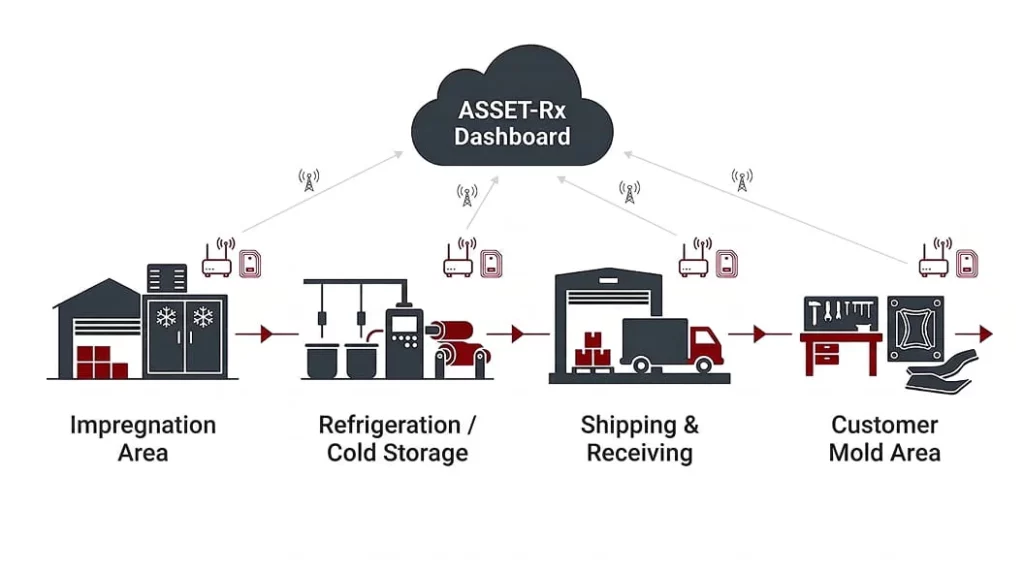
Out-Time: the clock that starts the moment the roll comes out
Every time a piece needs to be cut from a prepreg sheet or roll, the material has to come out of the freezer to somewhere close to room temperature. That period, from the moment the material leaves the cold environment to the moment the remaining roll goes back in, is called Out-Time. It has to be recorded on two axes at once: how long the material was out, and what temperature it was at while it was out, because both together determine how much the cure reaction actually advanced.
This isn’t a formality. A 2011 NASA Glenn Research Center study on IM7/977-3 prepreg, a common aerospace-grade material, aged samples at room temperature for up to 60 days and tracked the resin’s cure state with differential scanning calorimetry (DSC) and dynamic mechanical analysis (DMA). The manufacturer-rated out-life for that material was 30 days; a second resin system in the same study was rated at just 21 days. Even a material the researchers described as comparatively “robust” showed a measurable rise in modulus, meaning the resin was advancing toward cure, well before it ever saw an autoclave. The takeaway generalizes well beyond that one study: out-time isn’t a soft guideline, it’s a countdown with a real chemical process behind it, and every material has its own limit.
Cumulative Out-Time: the countdown doesn’t reset
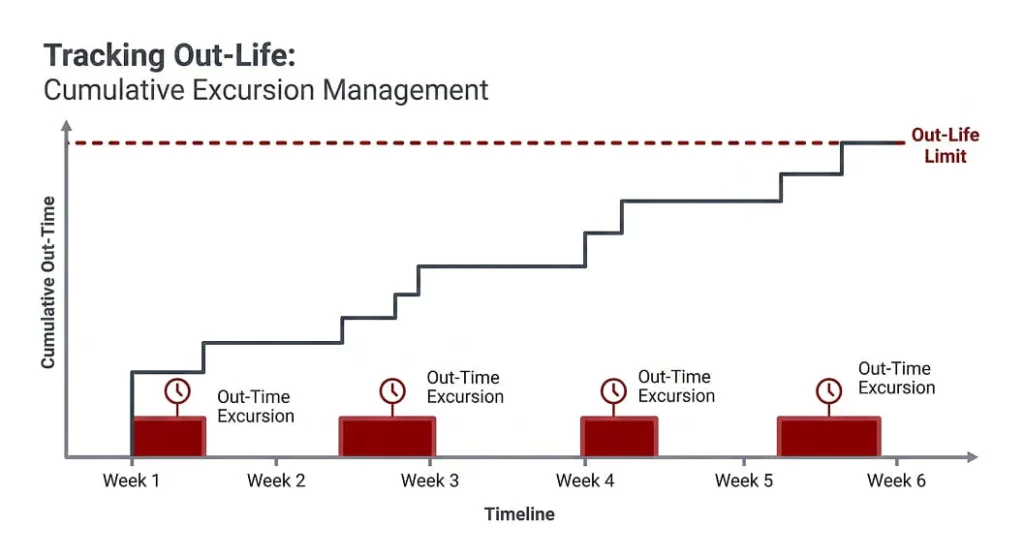
Here’s the part that trips up a lot of tracking systems that only watch one excursion at a time: out-time is cumulative. If a roll comes out for two hours on Monday to have a piece cut, goes back in the freezer, then comes out again for ninety minutes on Thursday for another cut, that roll hasn’t used “two hours” and then, separately, “ninety minutes.” It has used three and a half hours of its total out-life, and every subsequent excursion has to be measured against what’s left of that budget, not a fresh one.
That’s Cumulative Out-Time, the running total of every excursion a piece of material has experienced, tracked against the manufacturer’s out-life limit for that specific resin system. A roll, and every piece ever cut from it, carries this number for its entire working life, right up until it’s consumed or its out-life expires and it has to be scrapped. Miss this and you can have a roll that looks fine, feels tacky, and passes a visual check, but has already quietly used up most of its usable cure margin.
Why a mismatch between two rolls is worse than it sounds
Out-time control isn’t only about any single roll staying within its own limit. It’s also about consistency between rolls. When two pieces of prepreg, pulled from two different rolls or pouches, each with its own out-time history, end up laid together on the same mold, their tack and drape properties need to match closely enough that they behave the same way during layup and cure. Tack is how the plies stick to each other and to the tool; drape is how well the material conforms to a contoured surface without wrinkling or bridging. Both properties shift as out-time accumulates, and they don’t shift identically for two rolls with two different out-time histories, even if they’re nominally the same material and lot.
Lay up a part from mismatched material and the risk isn’t limited to a visible defect at the layup bench. Uneven cure advancement between plies can produce inconsistent cure kinetics through the laminate, which shows up later, during cure, during inspection, or worst of all, after the part is already in service. This is exactly why the requirement isn’t just “track out-time,” it’s “track out-time for every roll and every cut piece, individually and cumulatively, so you can prove any two pieces going onto the same mold are actually compatible.”
Doing this by hand doesn’t scale
For a long time, the industry’s answer to all of this has been a paper tag on the bag, a whiteboard, or a technician’s memory of when a roll last came out. It’s not that people don’t know out-time matters; everyone on a composites floor does. It’s that manually writing down a timestamp every time a roll moves, and then manually adding up every excursion across weeks of intermittent use, doesn’t hold up under real production pressure. A missed timestamp, a tag that falls off, a shift change with no clean handoff: any of these can silently erase the record you’d need to prove a roll is still good, or to catch it before it isn’t.
How LASSO-E and ASSET-Rx close that gap
This is the exact problem CRATUS built LASSO-E to solve. LASSO-E is an autonomous environmental recorder that travels with a prepreg roll, sub-roll, or pouch, and calculates both Out-Time and Cumulative Out-Time in real time, on the sensor itself, with no scanning, no manual stopwatch, and no paper tag. When a piece is cut from a monitored roll, LASSO-E’s record-splitting capability carries that piece’s full out-time history forward automatically, so nothing gets double-counted and nothing gets lost.

Every reading and every calculated remaining-shelf-life value flows into CRATUS’s ASSET-Rx™ platform, viewable on a dashboard or through your existing ERP or MOM system via open APIs, with alerts triggered automatically as a roll or a cut piece approaches its programmed out-life limit. It’s the same discipline the industry has always known it needed around TATS materials, just without the paper tags, the whiteboards, and the guesswork.
If out-time tracking at your shop still runs on memory and masking tape, it’s worth seeing what it looks like when the material tracks itself. Reach out to CRATUS at [email protected] to talk about putting a LASSO-E on your next roll.

Written by
Founder and CEO, CRATUS Technology, Inc.
Zeki founded CRATUS in 2013 and leads the San Jose team building LiDAR volume measurement systems, IoT sensing platforms, and energy and industrial automation hardware.
Full profileLinkedIn


Interested ?
We would be pleased to send you detailed information about our products or services.
Simply enter your details in the contact form below and we will get in touch with shortly.
CRATUS respects your personal information and keeps it safe. By sending this form, you consent to allow CRATUS to store and process your personal information as stated in our Privacy Policy.