

You Can’t Manage What You Can’t Measure:
Why Supply Chain Autonomy Starts at Receiving
Supply chain autonomy is the goal of most operations leaders right now: plans that adjust themselves, replenishment that triggers on its own, and fewer people reconciling spreadsheets. Most of these programs start in the ERP and the planning layer. Few start where the material enters the plant.
That is the gap. For bulk materials such as ore, aggregate, grain, feedstock, salt, pulp and biomass, the inventory number in the ERP is usually a book value. It is corrected once a month, sometimes once a quarter, by a drone flight, a surveyor, or someone with a tape and a calculator. Between surveys the system assumes receipts minus consumption equals what is on the ground. It rarely does.
When the input is wrong, every downstream decision inherits the error. Production schedules run against material that is not there. Safety stock grows to cover the uncertainty. Month-end write-offs absorb the difference. An autonomous system acting on a wrong number makes the wrong decision faster.
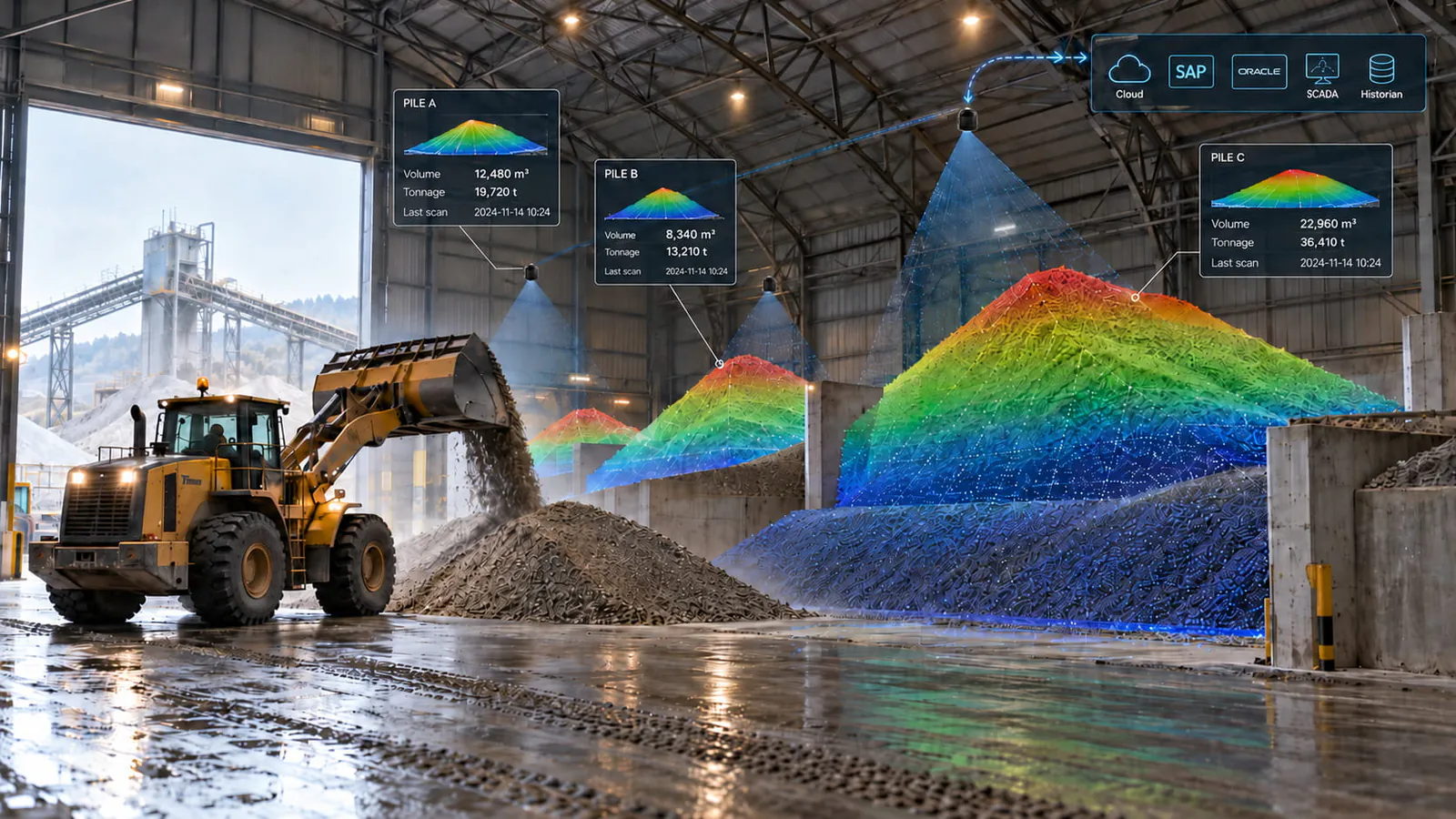
Measure first, then automate. CRATUS VMS uses LiDAR to measure stockpiles, silos, bunkers and bins continuously. Volume is converted to tonnage and published through open APIs to SAP, Oracle, Azure, AWS or any historian. The inventory figure becomes a measured value, refreshed on a schedule you set, not an estimate refreshed when someone has time.
CRATUS VMS is already integrated in customer plants through SCADA, including Ignition™ by Inductive Automation and other SCADA and historian platforms. The plant queries the edge unit, stores time-stamped volume readings in its own database and uses them at the frequency it needs.
What changes for the operation:
- Receiving and consumption are verified against measured change, not assumed.
- Planning and replenishment run on current inventory.
- Survey costs and month-end adjustments drop.
- Safety stock can be set from measured variance instead of fear.
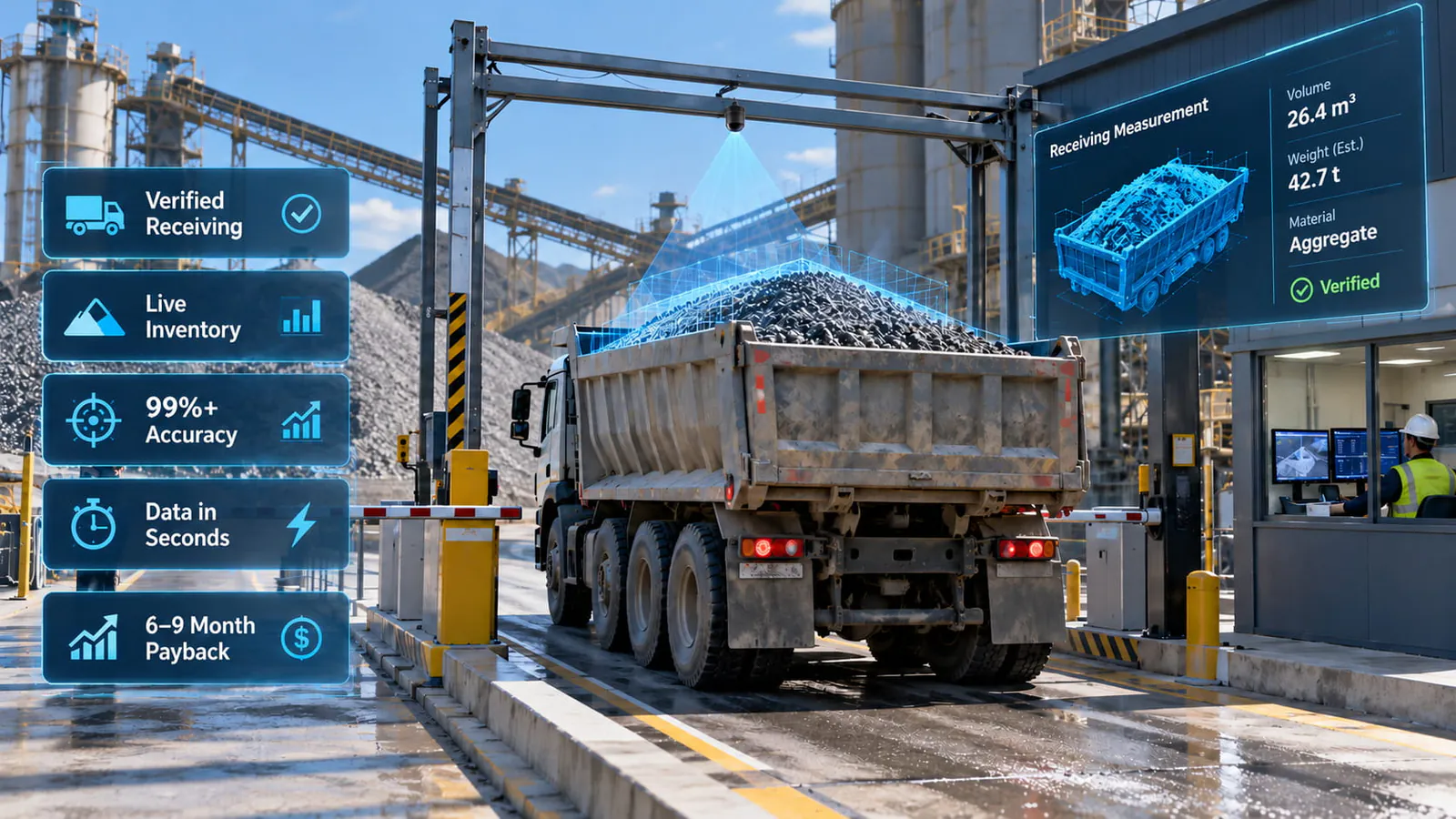
Customers report volume accuracy rising from 70% to 80% to 99%+, about 10 hours of survey and post-processing removed per cycle, and data available in seconds instead of 1 to 2 days. Typical payback is 6 to 9 months.
Supply chain autonomy is a data problem before it is an AI problem. You can’t manage what you can’t measure. Start at the gate.
FAQ: Supply Chain Autonomy and Bulk Inventory
What is supply chain autonomy?
Supply chain autonomy is the ability of planning and execution systems to sense conditions and act, such as triggering replenishment, without manual intervention. It depends on accurate, current inventory data at every stage, including raw material receiving.
Why do supply chain autonomy programs stall at bulk materials?
Bulk inventory is usually a book value corrected by monthly drone or manual surveys, at 70% to 80% accuracy. Autonomous systems acting on that number need human override, so the program stops at a dashboard.
How does LiDAR inventory measurement support digital supply chain transformation?
Fixed 3D LiDAR measures stockpiles, silos and bunkers continuously at 99%+ volumetric accuracy and publishes volume and tonnage to ERP, SCADA and cloud platforms. Planning and replenishment then run on measured inventory.
Can CRATUS VMS integrate with SAP, Oracle or SCADA systems?
Yes. Data is delivered through open APIs and through SCADA. Customer installations run on Ignition™ by Inductive Automation and other SCADA and historian platforms.
What ROI can a supply chain autonomy program expect from automated bulk measurement?
Customers report payback in 6 to 9 months, about 10 hours of survey work removed per cycle, and seasonal inventory mismatches reduced from hundreds of thousands of dollars to hundreds.

Written by
Founder and CEO, CRATUS Technology, Inc.
Zeki founded CRATUS in 2013 and leads the San Jose team building LiDAR volume measurement systems, IoT sensing platforms, and energy and industrial automation hardware.
Full profileLinkedIn
Interested ?
We would be pleased to send you detailed information about our products or services.
Simply enter your details in the contact form below and we will get in touch with shortly.
CRATUS respects your personal information and keeps it safe. By sending this form, you consent to allow CRATUS to store and process your personal information as stated in our Privacy Policy.