

From Eyeballing to 3D Automation:
Guessing Road Salt Inventory Is No Longer an Option.
The Winter Wake-Up Call: Why Municipalities Ran Out of Salt
Remember the recent winter seasons? Record-breaking early storms caught regions entirely off guard. Supply chains buckled. Major salt mines operated 24/7 but still couldn’t match the sudden surge in demand. From the Northeast through the Midwest, municipal public works departments and private contractors faced a harsh reality: widespread road salt shortages that forced cities to ration supplies, stop salting residential streets, and leave roads dangerously icy.
But if we look beneath the surface of these logistical bottlenecks, a glaring, systemic vulnerability is revealed: Most operations are completely blind when it comes to their real-time stockpile inventory.
When the winter weather gets unpredictable, relying on “eyeballs,” manual measurements, and historical guesswork to manage road salt storage bunkers is a recipe for crisis.
The Flaw in the Bunker: The Failure of Traditional Estimation
Managing bulk road salt in a storage bunker is notoriously difficult. Salt piles are irregularly shaped, prone to shifting, and often develop hidden cavities or steep, uneven slopes.
Traditionally, inventory management looks like this: a supervisor walks into the bunker, looks at a massive, uneven mound of rock salt, and makes an educated guess. Alternatively, they rely strictly on a paper trail—subtracting estimated truckloads used from the original delivery manifest.
This approach introduces severe points of failure:
- The Compounding Error: If your daily usage estimation is off by just 5%, after a multi-day blizzard event, your recorded data will say you have tons of salt left when your bunker is actually running on empty.
- The Reactive Trap: By the time you realize you are running out of salt, a regional shortage has already driven up prices, extended lead times, or choked shipping lanes.
- The Budget Drain: Over-ordering out of fear ties up municipal capital and wastes valuable, covered bunker space. Under-ordering puts public safety at immediate risk.
To survive unpredictable winters, facility managers and public works directors need a single source of truth: automated, continuous, real-time inventory visibility.
Enter the Light: Real-Time LiDAR Volume Estimation
To solve this inventory crisis, forward-thinking operations are turning away from manual guessing games and adopting advanced optical technology. Cratus Technology’s LiDAR-based Volume and Weight Estimation System brings aerospace-grade precision directly into the rugged environment of road salt storage bunkers.
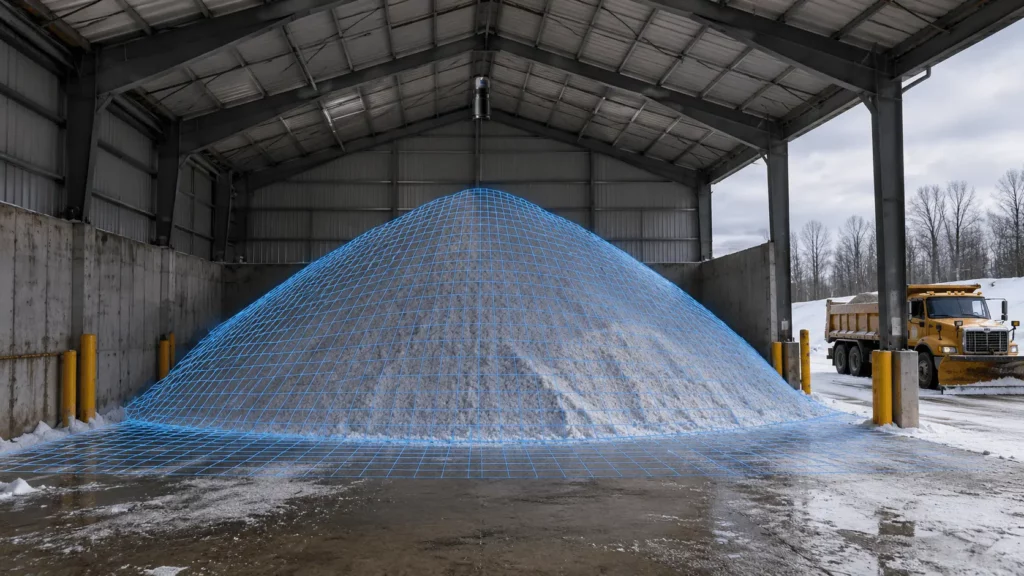
By mounting industrial-grade LiDAR (Light Detection and Ranging) sensors directly over salt stockpiles, the system fires millions of safe laser beams per second to create a dynamic, highly accurate 3D map of the material.
Learn more about how the technology works here: Cratus Technology LiDAR Volume Estimation Systems
Why LiDAR is a Game-Changer for Winter Maintenance Operations:
- Millimeter-Accurate 3D Mapping: Unlike human eyes or point-sensors, LiDAR maps the entire surface topology of the salt pile. It effortlessly calculates the exact volume of irregular slopes, peaks, and depressions, ensuring you know exactly how many cubic yards or meters are in your bunker.
- Real-Time Weight Translation: By pairing precise 3D volumetric data with known bulk material densities, the Cratus system translates volume into real-time tonnage. You always know your exact remaining weight capacity.
- Automated Low-Stock Alerts: Set custom thresholds. The moment your inventory drops below a safe level, the system triggers automated alerts. This gives your procurement team the buffer they need to place orders before the next winter storm causes a regional run on salt.
- Zero-Contact, Zero-Maintenance: Salt is highly corrosive and abrasive. Cratus’s non-contact LiDAR sensors are mounted safely out of reach of heavy machinery and corrosive dust, ensuring continuous operation without manual intervention.
- Cloud-Based Operations Dashboard: Public works directors, city managers, and supply chain vendors can monitor inventory across multiple regional salt domes simultaneously from any phone or desktop.
Stop Reacting to the Storm. Start Predicting It.
The lesson from recent road salt shortages is clear: waiting for the delivery truck to arrive before verifying your inventory is a high-stakes gamble. Public safety, municipal budgets, and operational efficiency depend entirely on accurate data.
With Cratus Technology’s LiDAR system, you can replace panic with precision. You will know exactly what you have, exactly what you need, and exactly when to buy—keeping your roads clear, your budgets intact, and your community safe.
Don’t let the next winter freeze leave you empty-handed. Explore the future of bulk inventory management today at Cratus Technology.

Written by
Founder and CEO, CRATUS Technology, Inc.
Zeki founded CRATUS in 2013 and leads the San Jose team building LiDAR volume measurement systems, IoT sensing platforms, and energy and industrial automation hardware.
Full profileLinkedIn
Interested ?
We would be pleased to send you detailed information about our products or services.
Simply enter your details in the contact form below and we will get in touch with shortly.
CRATUS respects your personal information and keeps it safe. By sending this form, you consent to allow CRATUS to store and process your personal information as stated in our Privacy Policy.