

Why 80% of Hardware Projects Fail in Prototyping | Cratus
Software moves fast and breaks things. Hardware just breaks your bank account. Here’s why the survivors look nothing like the Silicon Valley playbook, and what the next generation of hardware leaders are doing differently.
$930 Million Dollars. Liquidated.
That is not a typo. That is what Jawbone raised, from Sequoia, Andreessen Horowitz, BlackRock, and sovereign wealth funds, before quietly liquidating in 2017. A $3 billion peak valuation. Ten years of runway. The best industrial designers in the Bay Area. A household brand. Gone.
Jawbone was not alone in the cemetery. Juicero raised over $100 million before imploding when a journalist demonstrated that its $400 cold-press was, in fact, a hand. Pebble, the original Kickstarter record-setter, once the darling of the smartwatch revolution, sold its remains to Fitbit for somewhere between $34 million and $40 million. NJOY raised $181 million and still hit a billion-dollar valuation on the way down. Electric Objects, Hello, Lily Robotics, a graveyard’s worth of “visionary” hardware brands flamed out in a single 18-month window.
And it is not just the consumer crowd. A Cisco survey of 1,845 business and IT decision-makers found that roughly 75% of enterprise IoT projects are considered unsuccessful. CB Insights and industry estimates put the number of hardware startups that fail to reach mass production at 70% to 97%, depending on who’s counting. MacroFab’s analysis points to two brutal culprits: 42% fail on protracted development phases, and 34% fail on lack of product-market fit, often because by the time the prototype finally shipped, the market had already moved.
Eighty percent is a fair middle of the range. Eighty percent of hardware projects die before they become a product. The question worth asking is not why so many fail. It is why the survivors look so different from the playbook everyone else is running.
The Myth That Kills More Hardware Projects Than Anything Else

Somewhere around 2010, Silicon Valley collectively decided to apply the software playbook to hardware. Move fast. Break things. Ship MVPs. Iterate in production.
It does not work. It cannot work. And the graveyard above is the receipt.
Here is the asymmetry nobody wants to put in a pitch deck: when a software team ships a bug, the fix is a git push and a redeploy. When a hardware team ships a bug, the fix is a tooling change, a board respin, a re-certification, a new injection mold quoted at 8-to-12-week lead time, thousands of units recalled from the field, and a conversation with an insurance adjuster.
Industry veterans measure the reality like this: most hardware products endure three to eight prototype loops before production readiness. Each loop raises prototype cost by 15–40%. Mechanical parts compound at 40%+. A single connector change can cascade into a PCB redesign, an enclosure re-tool, a firmware patch, and a new EMC/FCC certification cycle. A realistic IoT-device timeline from concept to mass production sits at 12 to 18 months, and that is if nothing goes wrong. The component lead times on specialty silicon can stretch to 32 weeks by themselves. Components alone drive roughly 60% of a product’s lifetime cost.
Founders pitch investors six-month timelines. Investors pretend to believe them. Then reality arrives, the burn rate doubles, the seed round runs dry six months before the product is actually shippable, and another name joins the graveyard.
The Silos: Where Good Ideas Actually Die
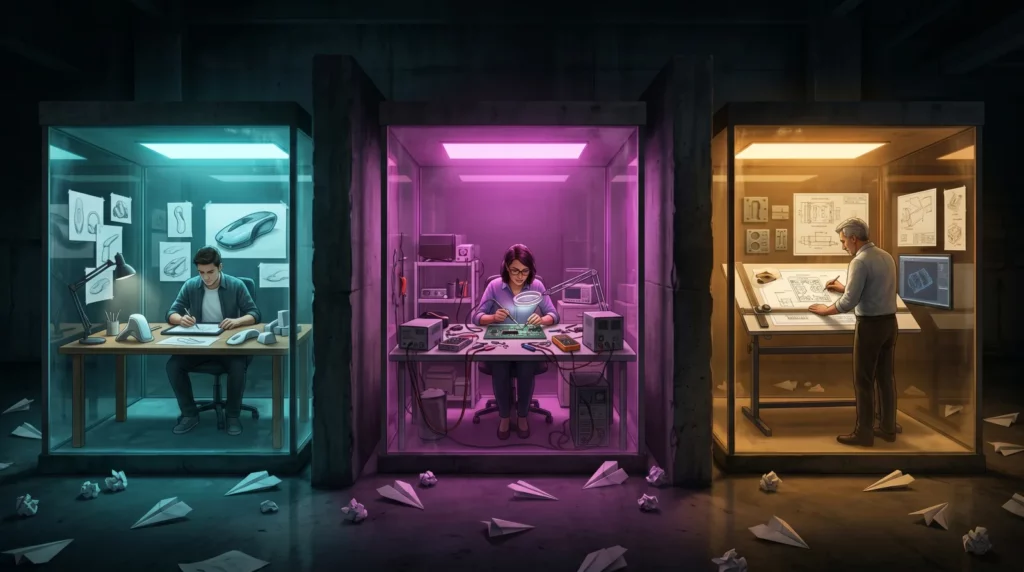
Even when a hardware team has the funding, the talent, and the vision, there is one failure mode that dominates every post-mortem: the silos.
The classical hardware org chart looks rational on paper:
- Industrial designers obsess over the product’s look, feel, ergonomics, and the CMF (color, material, finish).
- Mechanical engineers translate that aesthetic vision into something that actually holds together at temperature, under vibration, and through a drop test.
- Electronics engineers design the PCB, select components, route signal integrity, and chase EMC compliance.
- Firmware engineers write the low-level code that makes the silicon behave.
- Software and cloud engineers build the app and the backend.
- Manufacturing engineers (often at a completely separate contract manufacturer, sometimes on a different continent) try to make the design actually producible at volume.
Every single one of those disciplines is essential. Every single one is usually at a different company, on a different project management tool, reporting to a different P&L, speaking a slightly different technical dialect. And every single handoff between them is a moment where information is lost, assumptions diverge, and expensive rework becomes inevitable.
The industrial designer specs a radius the mechanical engineer can’t hold. The EE picks a BGA chip the contract manufacturer doesn’t have the pick-and-place tooling for. The firmware team finds a hardware bug six months into the schedule, a bug that a 15-minute conversation with the EE during layout could have prevented. The manufacturer reports yield problems at pilot run that trace back to a DFM issue nobody raised during the design freeze because nobody from manufacturing was in the room during the design freeze.
This is not a talent problem. It is a topology problem. And you cannot solve a topology problem by hiring more people into the existing topology.
The Antidote: One Team. One Roof. One Shared P&L.
Here is the pattern that separates the hardware survivors from the graveyard: they do not distribute the nine disciplines above across nine vendors. They collapse them into a single cross-functional unit that operates as one team, with one schedule, one definition of “done,” and one shared incentive to ship.
This is the idea Cratus Technology has been refining for more than a decade, and which it packages explicitly as the “Team-in-a-Box” engagement model.
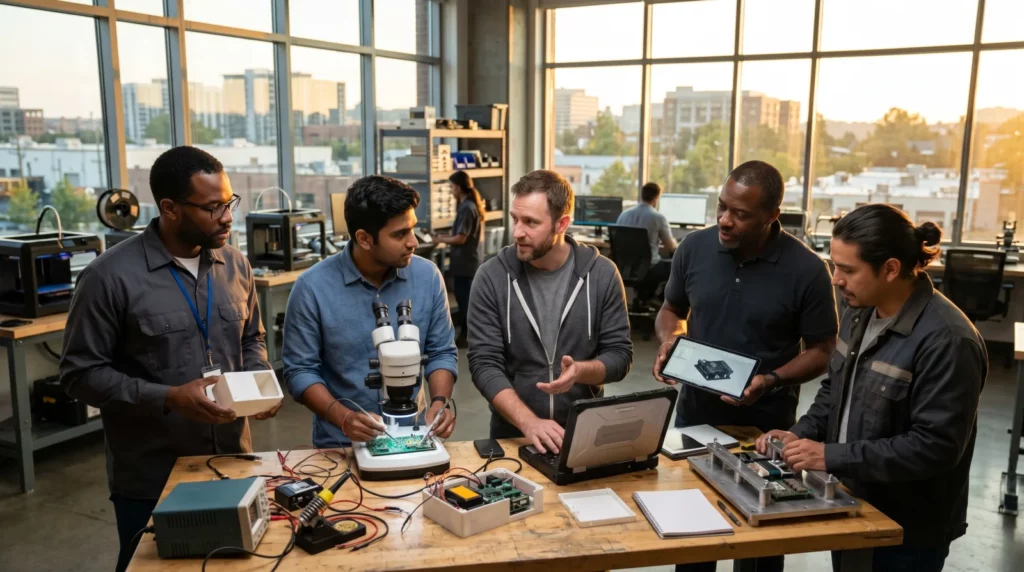
The premise is simple and for anyone who has lived through a failed hardware project it is revolutionary:
A fully integrated team of hardware, firmware, software, and mechanical engineers working together from the same workbench, the same BOM, and the same schedule. One partner. One P&L. From first sketch to final product.
That is Cratus’s own description of Team-in-a-Box. Translated into what it actually means for a company trying to ship a real product:
The designer talks to the EE before the enclosure is finalized. The EE reviews the pick-and-place library with manufacturing before the first board spin. The firmware team sees the schematic in draft form. The manufacturing lead weighs in on DFM during the architecture phase, not during pilot run. The handoffs don’t exist, because there are no handoffs. It is the same team, all the way down.
What Cratus Actually Delivers (Beyond a Slogan)
Team-in-a-Box is not a marketing phrase bolted on top of a traditional contract shop. It is how Cratus is structured:
- Product Planning and Design-as-a-Service: Deep up-front architecture, specifications, and documentation produced by the same team that will build the product. Early clarity, no translation layer.
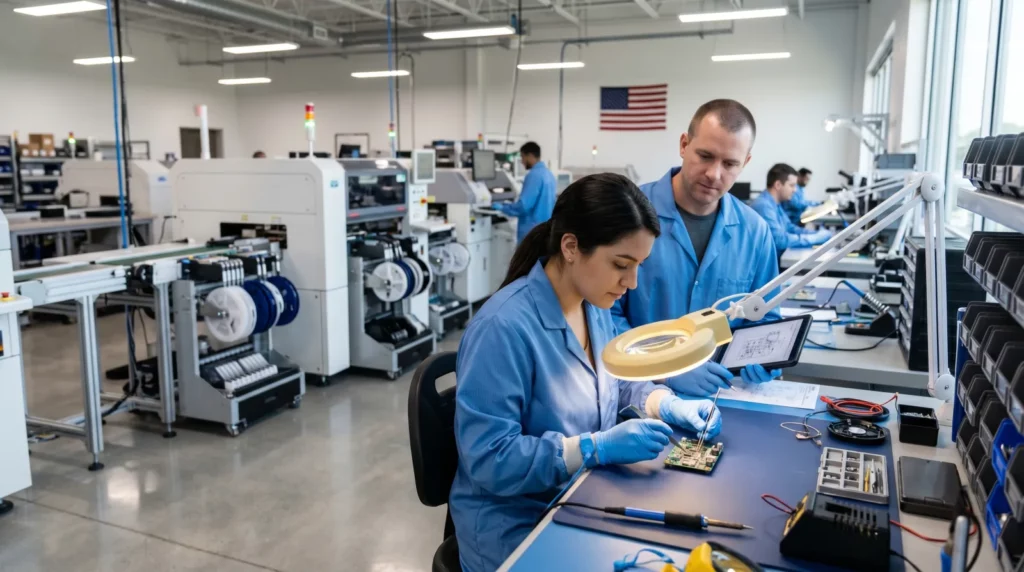
- Cross-disciplinary in-house expertise: Industrial design, mechanical, electronic hardware, firmware, software, wireless and wired connectivity, AI/ML modeling, enclosures, and product assembly. All under one roof.
- Rapid precision prototyping: Including in-house fabrication, reducing the lag between design iteration and a working unit in hand.
- Prototype-to-production continuity: The same engineers who designed the product run the pilot builds and manage the short-run manufacturing. No “thrown over the wall” moment.
- Made in USA manufacturing: Custom box builds and production handled domestically, which in 2026 is no longer a nostalgia play. It is a supply-chain resilience strategy. Transformer lead times, tariff volatility, and geopolitics have all made domestic manufacturing a defensible cost-of-doing-business bet.
And because no two hardware projects have the same shape, Cratus offers four deliberate engagement models:
- Fixed-Scope Engineering Projects: Defined deliverables with clear milestones. Ideal for well-understood, turnkey product development.
- Weekly Retainer / Design-as-a-Service: Ongoing collaboration with the cross-functional team. The most affordable option for dynamic, evolving roadmaps where requirements will keep moving.
- Prototype-to-Production Support: Concept through pilot build through short-run manufacturing, all in the same hands.
- Licensing & IP Transfer: Flexible IP models: retain full ownership, license Cratus technology, or structure staged transfers.
The portfolio underneath these models is not theoretical. Cratus has shipped hundreds of products, prototypes, and POCs across scientific instrumentation, battery and BESS systems, NVIDIA Jetson-based edge AI, LiDAR vision, medical devices, defense and aerospace, EV charging infrastructure, industrial automation, precision agriculture, and mining. The full stack isn’t a claim. It is a deployment history.
The Economic Case: What “De-Risking” Actually Saves
Let’s put numbers on why this topology matters.
A typical prototype loop costs a hardware startup somewhere between $50K and $250K, depending on complexity. Eight loops at 15–40% cost escalation compounds to a burn number most founders cannot defend to their board. Failing an FCC, CE, or UL certification resets the schedule by three to six months. A single injection-mold change costs another $15K–$80K and 8-to-12 weeks of calendar time.
Meanwhile, the hidden cost most teams never calculate: the opportunity cost of the extra year. By the time a distributed, siloed team shepherds a product through sixteen months of stop-and-start development, the market has moved. Competitors have shipped. Component obsolescence has forced a redesign. The product-market fit you tested at concept stage has shifted. This is the 42% failure-on-timeline number staring back at you.
A Team-in-a-Box engagement compresses that cycle by collapsing the handoff overhead, parallelizing disciplines that traditionally run sequentially, and keeping DFM on the table from day one. It is not magic. It is topology.
The Real Decision Is Architectural, Not Tactical
If you are a founder, a product lead, or an enterprise innovation executive looking at a hardware initiative this quarter, the question is not which contract manufacturer to shortlist. That is a tactical question, and the answer changes every year.
The real question is architectural: Are you going to try to orchestrate six separate vendors yourself, hope they all stay in sync, and watch your timeline compound, or are you going to engage a single cross-functional team that already works together and ship faster with less risk?
Eighty percent of hardware projects die in prototyping. They die for structural reasons, not talent reasons. And the antidote is equally structural.
Cratus Technology, Inc. is a U.S.-based product and technology development company delivering end-to-end engineering services through its Team-in-a-Box model, from first sketch to final product. Cross-disciplinary engineers across hardware, firmware, software, mechanical, AI, and manufacturing under one roof. Hundreds of products shipped across energy, defense, medical, industrial, and scientific markets. Made in the USA.
If you are staring at a prototyping timeline that keeps slipping and a BOM that keeps changing, schedule a free consultation at cratustech.com. We’ll send engineers, not a sales deck.

Written by
Founder and CEO, CRATUS Technology, Inc.
Zeki founded CRATUS in 2013 and leads the San Jose team building LiDAR volume measurement systems, IoT sensing platforms, and energy and industrial automation hardware.
Full profileLinkedIn

Interested ?
We would be pleased to send you detailed information about our products or services.
Simply enter your details in the contact form below and we will get in touch with shortly.
CRATUS respects your personal information and keeps it safe. By sending this form, you consent to allow CRATUS to store and process your personal information as stated in our Privacy Policy.