

The Next Great Blackout: Why Relying on the National Grid is a Multi-Million Dollar Risk for Manufacturers
For decades, “the plug” was invisible infrastructure. In 2026, it is the single biggest line item on your risk register, and most executive teams still do not know it.
The $1.7 Million Hour Nobody Budgets For
Here is the number that should be stapled to every CFO’s monitor this quarter: $1.7 million per hour.
That is the average cost of a single hour of unplanned downtime in industrial manufacturing today, according to a 600-respondent survey Fluke published in late 2025. Stretch that incident to a common 12-hour recovery window, and one event, just one, wipes out more than $20 million. Across the sector, unplanned downtime is bleeding manufacturers up to $852 million every single week. Siemens puts the annualized damage at the Fortune Global 500 level at roughly $1.4 trillion. That is 11% of revenue. Gone.
And here is the uncomfortable truth leadership teams are beginning to face in 2026: a rapidly growing share of those incidents do not originate inside the fence line. They begin at the substation.
Texas. California. Virginia. The Pattern Is Getting Loud.
If you thought the Texas winter storm of 2021 and the rolling California brownouts were anomalies, look at the last eighteen months.
In July 2024, a single voltage fluctuation in northern Virginia triggered the simultaneous disconnection of 60 data centers, dumping roughly 1,500 megawatts of unwanted supply onto the grid and forcing emergency adjustments to stop the cascade. In early 2026, Austin’s own City Manager office warned that proposed local AI data centers could demand more power than the entire city’s peak load. AEP Ohio has flat-out paused new data center interconnections. Virginia, home to the world’s largest concentration of data centers, now consumes roughly one in every five kilowatt-hours its largest utility produces.
Then there is the pricing signal. PJM Interconnection, the grid operator serving 65 million Americans from New Jersey to Illinois, cleared its 2026/27 capacity auction at the maximum allowable price, a tenfold jump over 2022 levels. PJM itself projects a 6-gigawatt shortfall against its reliability requirements by 2027. Morgan Stanley models a 49 GW shortfall across the U.S. by 2028.
Retail electricity prices are up 42% since 2019, outpacing general inflation by 13 points. The grid your plant depends on is already oversubscribed, and the queue behind you, EV fast-charging corridors, AI training clusters, electrified heating, is only getting longer. Public power is no longer a utility. It is a competitive constraint.
The Slow Killer: “Dirty Power” Is Eating Your Machines Alive
Here is what most plant managers miss: the catastrophic outage is not actually the biggest threat. The invisible one is.
Voltage sags. Harmonic distortion. Transient spikes. Frequency deviations. Phase imbalance. These are the fingerprints of “dirty power”, and they rarely trip your lights off. Instead, they quietly cook your variable frequency drives, degrade capacitors, foul up precision CNC positioning, and shave months off the life of every motor on your floor.
ABB research shows 83% of industrial decision-makers now agree an unplanned downtime hour costs at least $10,000, with more than three-quarters seeing hourly costs run up to $500,000. Worse, Siemens data indicates the average time to restart after a stoppage has climbed from 49 minutes to 81 minutes. Plants are not only going down more, they are coming back up slower.
Most facilities learn they had a power quality problem only in the post-mortem. Usually right after a $200,000 drive unit blows, or a batch of precision parts fails QC for reasons no one can pin down.
Energy Independence Is No Longer a Lifestyle Choice, It Is Industrial Strategy
For the last two decades, “energy independence” conjured images of solar cabins and doomsday preppers. That framing is obsolete.
In 2026, energy independence is a board-level resilience strategy. It is how forward-looking manufacturers are locking in three things the public grid can no longer promise:
- Firmness: power that is actually there when the line runs.
- Cleanliness: voltage and frequency inside the tight bands precision equipment demands.
- Price stability: insulation from capacity-market auctions clearing at 10× historical norms.
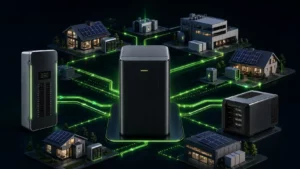
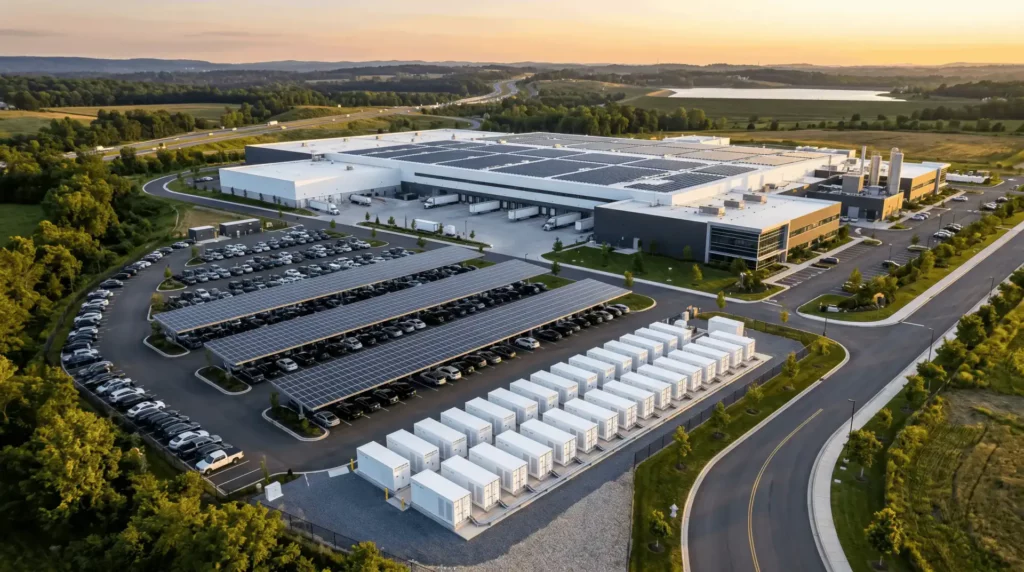
The architecture that delivers all three is now well-understood: on-site generation (solar, gas, or hybrid) + Battery Energy Storage Systems (BESS) + an intelligent microgrid controller that can seamlessly island your facility from the grid the moment upstream conditions go sideways, and rejoin the moment they recover.
This is no longer a moonshot. It is a procurable solution.
The Cratus Playbook: Intercal8, Microgrids, and a New Operational KPI
This is exactly the architecture Cratus Technology has been engineering for industrial clients through its Intercal8 energy and power management brand, and it is why we think about grid risk differently than a pure equipment vendor.
Intercal8 Battery Energy Storage Systems, designed in capacities from 100 kWh to 5 MWh, give manufacturers the buffer to ride through grid events, shave peaks, participate in demand response, and arbitrage time-of-use pricing. Whether the use case is peak shaving, UPS-grade backup, frequency regulation, or full islanded operation, the BESS is the backbone.
Custom Battery Management Systems (BMS) and pack electronics, built in-house for chemistries, form factors, and duty cycles that off-the-shelf systems cannot touch, are what keep the storage layer safe, long-lived, and actually delivering the cycles the business case promised.
Intercal8 Microgrid Controllers handle the real work of energy independence: auto-switching between grid-former and grid-follower modes, orchestrating distributed energy resources (DERs), managing Virtual Power Plant (VPP) participation, and executing the sub-cycle decisions that turn a pile of hardware into a resilient, revenue-generating asset.
Intercal8 Energy Management Software (EMS) ties it all together, hardware-agnostic, vendor-neutral, and built for the messy reality of multi-OEM industrial sites. Real-time monitoring, load forecasting, asset performance analytics, ROI tracking, and carbon accounting in a single pane of glass.
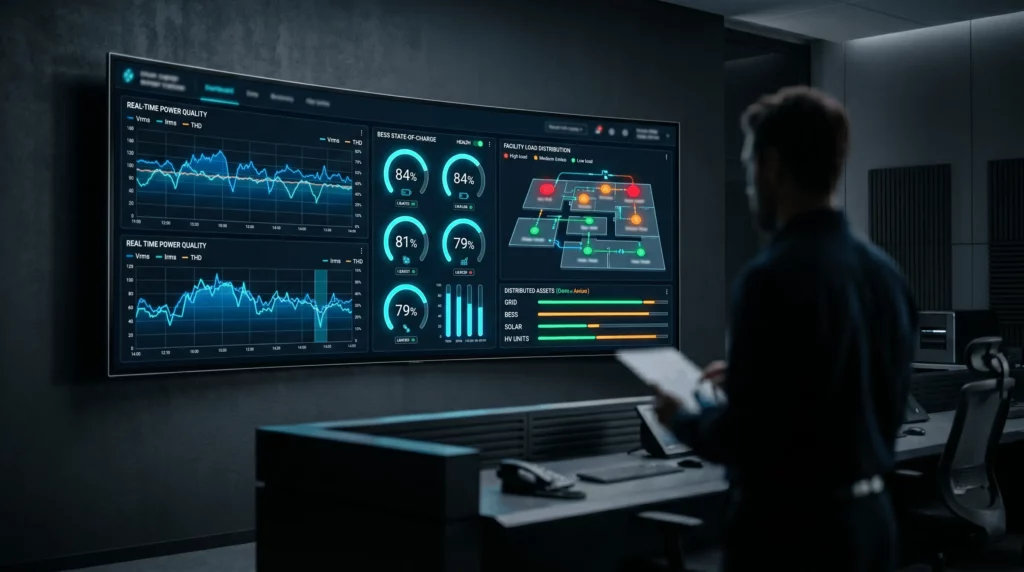
The KPI Your Board Is Missing: Power & Load Quality
Here is the strategic idea Cratus has been pushing to forward-thinking operations leaders, and it is the one worth writing down:
Power and load quality is the leading indicator of machine health and operational profitability.
You already track OEE. You track MTBF, yield, scrap rate, and throughput. But every single one of those is a trailing indicator, by the time they move, the damage is done.
The electrical signature a machine draws, harmonic content, power factor drift, micro-sag response, inrush behavior, changes before the machine fails. It changes before the batch goes out of spec. It changes before the VFD blows. Monitoring the quality of power drawn by each individual asset gives you a predictive layer the entire industry is currently leaving on the table.
This is why Cratus’s approach fuses the energy stack (Intercal8 BESS, microgrid controllers, BMS) with the operational intelligence stack (Asset-Rx, Workflow Studio, edge AI). Energy is not just an input. It is a sensor. And the data it produces, read correctly, is a leading indicator of profitability.
What To Do On Monday Morning
If your facility consumes more than a few megawatt-hours a week, three moves belong on this quarter’s agenda:
- Audit your exposure. Calculate a real dollar-per-hour downtime cost for each critical line. Most organizations underestimate it by 3–5×.
- Baseline your power quality. You cannot manage what you do not measure. Install metering that captures harmonics, sags, transients, and phase behavior per asset, not just at the main.
- Model the microgrid business case. With capacity prices up 10×, utility rates up 42%, and outages trending toward $1.7M/hour, the ROI math on on-site generation + BESS has shifted decisively in the last 24 months. Run it again.
The next great blackout is not a question of if. It is a question of whether your plant is a casualty of the grid, or a resilient island that keeps shipping while your competitors go dark.
Cratus Technology, Inc. engineers the physical, digital, and connected infrastructure that industrial manufacturers depend on, from custom battery packs and microgrid controllers under the Intercal8 brand, to operational intelligence platforms that turn real-world data into profitability. Made in the USA. Shipped globally.
Want to model the downtime and power-quality exposure at your facility? Reach out at cratustech.com, we’ll send an engineer, not a salesperson.

Written by
Founder and CEO, CRATUS Technology, Inc.
Zeki founded CRATUS in 2013 and leads the San Jose team building LiDAR volume measurement systems, IoT sensing platforms, and energy and industrial automation hardware.
Full profileLinkedIn

Interested ?
We would be pleased to send you detailed information about our products or services.
Simply enter your details in the contact form below and we will get in touch with shortly.
CRATUS respects your personal information and keeps it safe. By sending this form, you consent to allow CRATUS to store and process your personal information as stated in our Privacy Policy.