

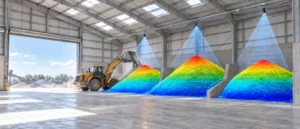
AI Inventory Management Needs Measured Inputs, Not Book Values
AI inventory management promises better forecasts, leaner stock and fewer stockouts. The models are capable. The question is what they are fed.
For discrete goods, the data is good: barcodes, RFID and transactions give an accurate count. For bulk materials, the count is a calculation. Tons received are logged from scale tickets, tons consumed are estimated from production, and the difference is assumed to be on the pile. Moisture, spillage, compaction, theft and scale drift all widen the gap between the book and the ground.
A forecasting model trained on that data learns the error. It recommends reorder points that are too high or too low, and planners stop trusting it. The project is labeled an AI problem when it is a measurement problem.
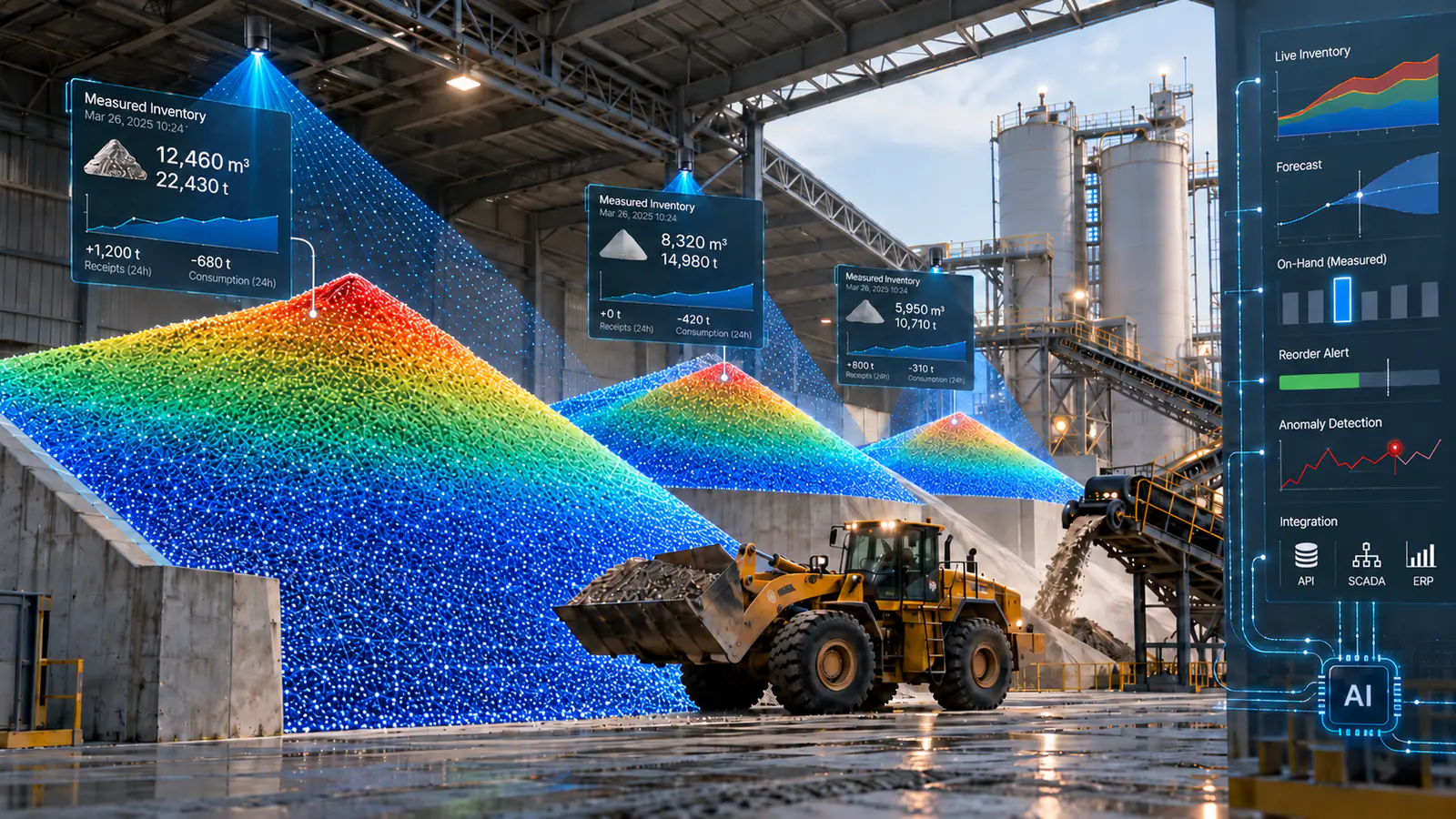
Give the model a measured number. CRATUS VMS measures bulk inventory directly with 3D LiDAR, at intervals from minutes to hours. Each reading is a time-stamped volume and tonnage, available by API to the planning platform, the data lake or the model itself. The model sees actual consumption rates, actual receipts and actual on-hand.
In customer installations, volume accuracy moved from 70% to 80% with visual and manual methods to 99%+ with LiDAR. Readings flow into Ignition™ and other SCADA platforms, where they are stored time-stamped and available to the planning model.
Results consultants and planners can show:
- Forecasts trained on measured inventory, not reconstructed book values.
- Anomaly detection on receipts and consumption, catching short loads and losses.
- Reorder points set from real variance.
- Audit-ready history for every pile and silo.
AI inventory management works when the inventory is measured. CRATUS supplies that layer as a managed service, so the AI team does not have to become a sensor team.

FAQ: AI Inventory Management for Bulk Materials
What is AI inventory management?
AI inventory management uses machine learning to forecast demand, set reorder points and flag anomalies. Its results depend on the accuracy and frequency of the inventory data it is trained and run on.
Why do AI inventory models underperform on bulk materials?
Bulk on-hand figures are calculated from scale tickets and production estimates, not measured. Moisture, spillage, compaction and scale drift create errors the model learns and repeats.
How accurate is LiDAR bulk inventory data for AI models?
CRATUS VMS delivers 99%+ volumetric accuracy in engineered and calibrated installations, compared to 70% to 80% for visual and manual methods. Readings are time-stamped, minutes to hours apart.
How does measured inventory data reach an AI or planning platform?
Through open APIs to the data lake, ERP or model, or through SCADA such as Ignition™ by Inductive Automation. Data is processed on site at the edge, so cloud is optional.
Can consulting firms use CRATUS VMS in AI and digital twin engagements?
Yes. CRATUS provides the measured physical data layer as a managed service, so the consulting team focuses on models, planning and process change.

Written by
Founder and CEO, CRATUS Technology, Inc.
Zeki founded CRATUS in 2013 and leads the San Jose team building LiDAR volume measurement systems, IoT sensing platforms, and energy and industrial automation hardware.
Full profileLinkedIn
Interested ?
We would be pleased to send you detailed information about our products or services.
Simply enter your details in the contact form below and we will get in touch with shortly.
CRATUS respects your personal information and keeps it safe. By sending this form, you consent to allow CRATUS to store and process your personal information as stated in our Privacy Policy.