
Blind Spots Cost Lives:
How 3D LiDAR is Making Industrial Accidents Obsolete
Every four days, a forklift kills an American worker. Every nine days, it’s a crane. The technology to stop this already exists, most facilities just haven’t installed it yet.
The Number That Should End This Conversation
OSHA’s own estimates are blunt: between 75 and 95 American workers are killed by forklifts every year. Another 35,000 to 62,000 are injured. More than one in six workplace deaths in the United States involves a forklift, one of the most common pieces of equipment on your floor.
Cranes are no gentler. The U.S. Bureau of Labor Statistics averages 42 to 44 crane-related deaths per year. A recent review of just 249 overhead crane incidents surfaced 838 separate OSHA violations, 133 injuries, and 133 fatalities. The Crane Inspection & Certification Bureau estimates that roughly 90% of those accidents are caused by human error, the single variable that no amount of training has ever fully eliminated.
And here’s the part that makes this a 2026 problem, not a 2010 problem: warehouse employment in the U.S. is up more than 80% since 2010 on the back of e-commerce. Injury rates inside fulfillment centers now run at more than double those of traditional warehouses. More people. More machines. More speed. Same blind spots.
The industry’s default response, hard hats, safety tape on the floor, a CCTV camera in the corner, is a set of tools built to document accidents. Not prevent them.
The Quiet Failure of the “Safety Camera”
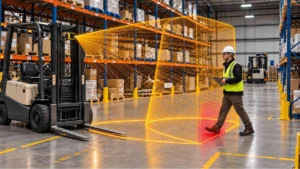
Walk into ten industrial facilities in 2026 and you will find roughly the same safety tech stack: a patchwork of 2D RGB cameras, proximity sensors around the equipment, maybe a pressure mat, and floor tape defining “pedestrian only” zones.
Every element of that stack has the same core problem: it was designed for a clean, well-lit office park. It was not designed for a port at 3 a.m. in the rain, a concrete plant in a dust storm, or a steel mill at 900°F.
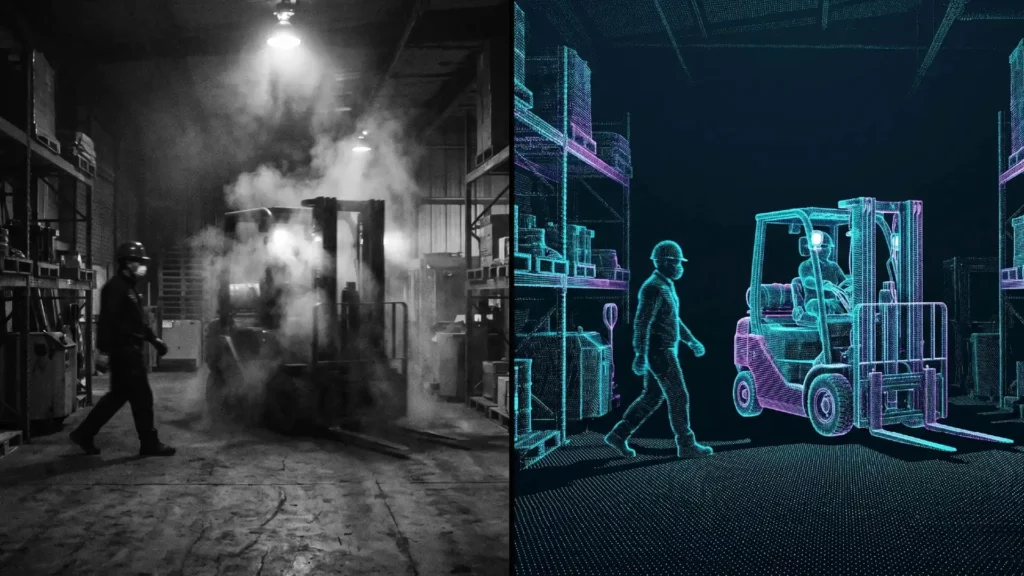
Standard 2D cameras fail in real industrial conditions. They drop resolution in low light. They blind out in direct sunlight. They fog up. They cannot reliably see through steam, dust, snow, or backlight. And the one thing they fundamentally cannot do, no matter how many megapixels you throw at them, is measure distance. A camera sees a flat image. A pedestrian ten feet away and a pedestrian ten inches away produce almost identical pixels. By the time software figures out which is which, the forklift has already moved another three feet.
Proximity sensors don’t classify. A basic IR or ultrasonic sensor trips on a pallet, a passing bird, or the crane’s own counterweight with the same confidence it trips on a human. The result: alarm fatigue. Operators silence the system.
Floor tape and barriers are static. The danger zone under a crane’s hook block moves as the load travels. A painted rectangle on the concrete is fiction the moment the load swings.
This is why, despite billions spent on legacy “safety” infrastructure, the fatality statistics have barely moved in a decade. The tools were never built to solve the problem. They were built to give lawyers something to play back after.
Enter 3D Perception, a Sensor That Doesn’t Care if the Lights Are On
Here is the fundamental shift: LiDAR does not see. It measures.
A LiDAR sensor fires millions of laser pulses per second and times exactly how long each one takes to return. The output isn’t an image. It’s a live 3D point cloud, a living, millimeter-accurate geometric model of the real world, refreshed dozens of times per second.
That simple physical difference changes everything:
- Lighting is irrelevant. LiDAR works in pitch black, direct sunlight, floodlight glare, and every condition in between. The laser doesn’t care.
- Depth is not inferred, it’s native. Every point in the cloud has an exact X, Y, Z coordinate. Distance between a forklift and a pedestrian is a calculation, not a guess.
- Weather degradation is predictable and engineerable. Modern automotive-grade LiDARs from manufacturers such as HESAI and SEYOND, the same ones powering Level 4 autonomous vehicles, are built to OEM reliability standards for rain, fog, and dust, with multi-return processing and point-cloud filtering that 2D imaging cannot match.
- False positives drop dramatically. When your sensor knows the exact shape and trajectory of every object in its field of view, telling a human from a forklift from a swinging load stops being a probability problem and starts being a geometry problem.
This is the leap the autonomous vehicle industry made nearly a decade ago, and why every major self-driving program eventually came back to LiDAR as the reliability layer they could bet lives on. Industrial safety is finally catching up.
But a Point Cloud Alone Saves No One
Here’s the part vendors skip over: a raw LiDAR point cloud is not a safety system. It’s a data firehose.
A single HESAI or SEYOND unit can output hundreds of thousands of points per second. Turning that into a decision, that’s a human, not a pallet; they are 4.2 meters from the hook block; the hook is swinging toward them at 1.3 m/s; trigger the e-stop NOW, requires three very hard things done simultaneously:
- Classification AI that runs on rugged edge hardware, not a cloud server in another state. Network latency is not a valid safety strategy.
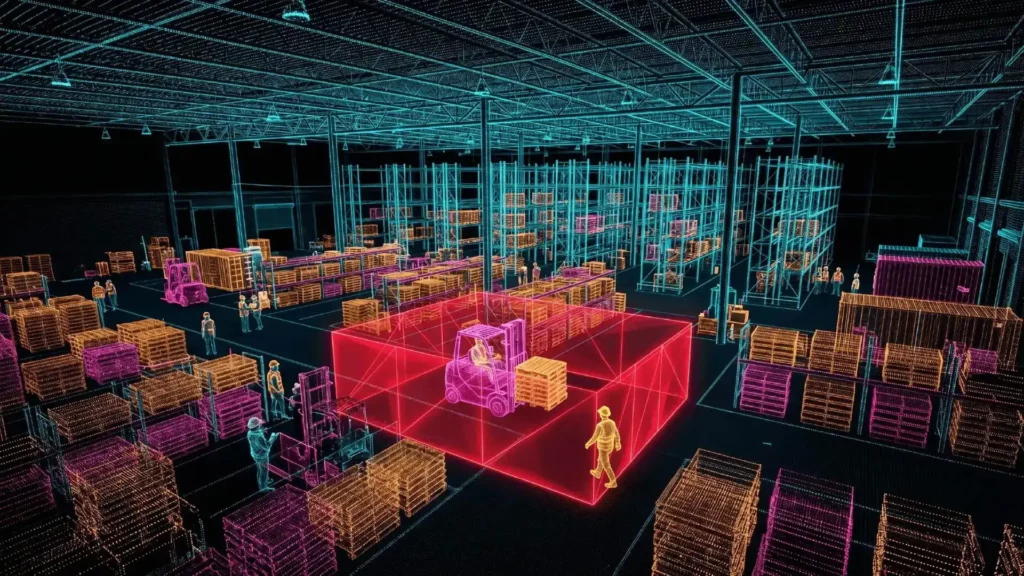
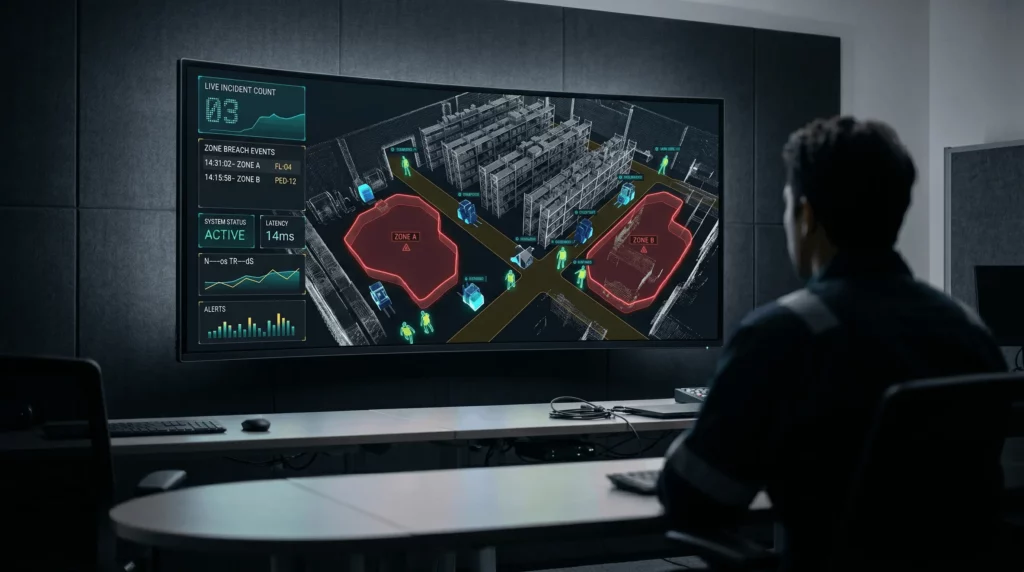
- Zone logic that adapts to moving equipment. The exclusion zone under a telescoping crane boom is not a static box. It travels with the hook.
- Millisecond-latency integration into actual equipment controls — GPIO, RS-485, CAN bus, Modbus, PLC — so the system doesn’t just warn, it acts.
This is the gap between “we have a LiDAR” and “we have prevented an accident.” It is also exactly the gap Cratus Technology has spent years engineering to close.
The Cratus Playbook: From Point Cloud to Prevented Accident
Cratus doesn’t just resell LiDAR sensors. Cratus engineers the full stack between the sensor and the safety-critical decision, which is the only part that actually saves lives.
Industrial-grade sensor partnerships. Cratus is an integration partner for both HESAI and SEYOND, the two most credible names in mechanical and solid-state LiDAR for industrial and automotive use. This matters because sensor selection is not generic, port environments, crane booms, and confined warehouse aisles each require different range, field-of-view, and point-density profiles. Cratus specs the sensor to the application, not the other way around.
The SOHO Crane & Heavy Equipment Safety system. Purpose-built for mobile and fixed cranes (crawler, floating, gantry, tower, hammerhead, bulkhandlers, telescopic), excavators, backhoes, trenchers, and hoisting equipment. Key specs that matter:
- Trigger latency under 300 milliseconds from detection to e-stop / alarm output. Faster than any human reaction.
- Detection range up to 150 feet with 108° per-camera field of view, scaled to application.
- Configurable danger zones, including dynamic zones that track the hook block as a telescoping boom extends or retracts.
- Up to four monitored zones per unit, each with independent rules and response actions.
- Edge-based AI. All detection happens locally. No internet required. No cloud latency. No single point of failure at the WAN.
- Built for industrial reality. -20°C to +60°C operating range, vibration resistant for boom-mounted installation, IP-rated enclosures, 24–54V DC or 120V AC power.
- Standards-aligned. Designed to be compatible with OSHA 1926 and ANSI B30, the frameworks your compliance team is already writing policy against.
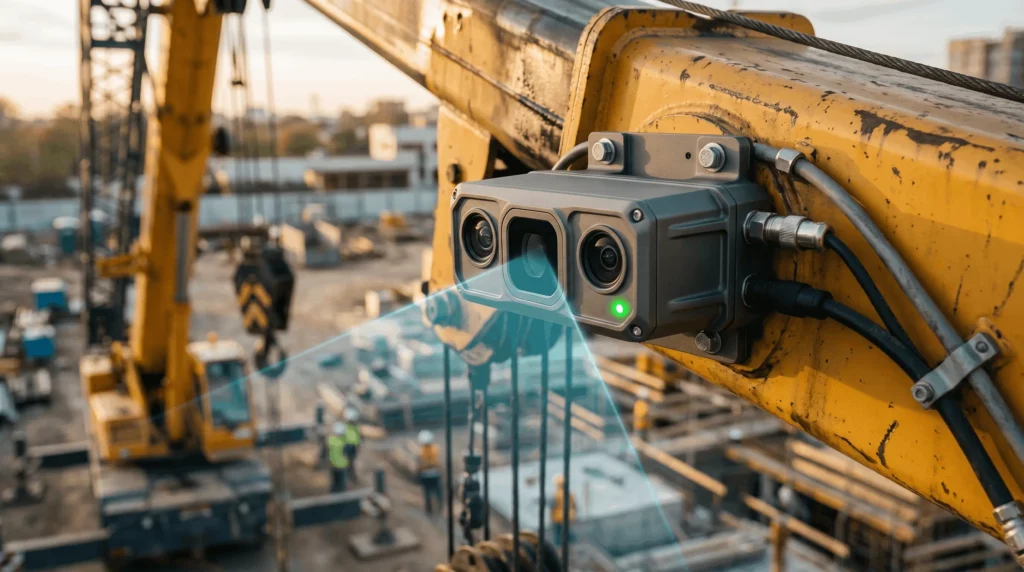
Integration that actually integrates. GPIO triggers for e-stops, alarms, and warning lights. RS-485 / Modbus into PLC and SCADA stacks. HTTP / UDP APIs into HMI dashboards. Three operating modes, standalone, PLC-connected, or software-integrated, so the system fits whether you’re retrofitting a 20-year-old gantry or commissioning a new-build terminal.
Custom model tuning. Detection logic is proprietary, and Cratus trains and re-trains models against your site conditions, load profiles, and pedestrian traffic patterns. This is not a box you buy and hope works. It is an ongoing safety system that gets smarter.
The ROI Conversation Nobody Wants to Have Out Loud
Let’s be honest about what’s really on the line.
A single fatal OSHA violation starts at $16,550 and willful or repeat violations can climb to $165,514 per citation. The average workers’ compensation claim for a serious forklift injury hovers around $41,000. A wrongful death settlement in heavy-equipment cases regularly lands in the seven to eight figures. And none of those numbers capture the three hidden costs that actually hurt: production downtime while OSHA investigates, insurance premium escalation for the next three policy cycles, and the quiet but real cost of turnover when a plant gets a reputation for unsafe conditions.
A Cratus SOHO installation is a fraction of a single one of those events. The unit economics are not subtle.
The Strategic Shift: Safety as a Sensor Network, Not a Policy Binder
The deeper idea worth internalizing: in a facility outfitted with edge-AI-powered 3D perception, every sensor is now a safety sensor, an operations sensor, and an analytics sensor simultaneously.
The same SOHO deployment that prevents a crane strike also produces a continuous dataset on near-miss events, traffic pattern bottlenecks, loading dock dwell times, and equipment utilization. Cratus’s broader platform, Asset-Rx for operational intelligence, Asset-Rx Edge for on-device inference, Workflow Studio for physical process planning, is designed to compound that data into operational advantage, not to let it rot in a DVR somewhere.
Put more plainly: the ROI on prevention pays the safety bill. The ROI on the data pays for the rest of the system.
What To Do Before the Next Near-Miss
Three moves worth putting on the operations leadership agenda this quarter:
- Inventory your real blind spots. Walk every crane, forklift, and loading zone with a camera off and a clipboard on. Write down every scenario where your existing safety layer would fail, sunset glare on the east-facing dock, steam at the blanch line, dust on the aggregate conveyor. That list is your specification document.
- Benchmark your near-miss data. If you don’t have it, that’s the first finding. If you do, map where the clusters are. Near-misses are the leading indicator of the next fatality.
- Request a site assessment, not a brochure. A real 3D-perception safety system is specified, not configured. Ask the vendor to walk the floor with you. If they don’t, keep shopping.
The blind spot isn’t in the camera. It’s in the assumption that yesterday’s safety stack is good enough for tomorrow’s tempo. In an industry where a single prevented incident pays for the entire installation, the only expensive decision is the one you don’t make.
Cratus Technology, Inc. engineers the physical, digital, and connected infrastructure that industrial operators depend on, from HESAI and SEYOND LiDAR integration, to the SOHO Crane & Heavy Equipment Safety system, to edge-AI operational intelligence built on Asset-Rx and Workflow Studio. Made in the USA. Deployed globally.
Want a site walk-through and a zero-obligation risk assessment of your crane or forklift operations? Reach out at cratustech.com, we’ll send an engineer, not a salesperson.

Written by
Founder and CEO, CRATUS Technology, Inc.
Zeki founded CRATUS in 2013 and leads the San Jose team building LiDAR volume measurement systems, IoT sensing platforms, and energy and industrial automation hardware.
Full profileLinkedIn
Interested ?
We would be pleased to send you detailed information about our products or services.
Simply enter your details in the contact form below and we will get in touch with shortly.
CRATUS respects your personal information and keeps it safe. By sending this form, you consent to allow CRATUS to store and process your personal information as stated in our Privacy Policy.