


The Ultimate Grid Hack:
How the NVIDIA and SPAN.IO Partnership for Distributed Data Centers Rewrites Infrastructure in the Shadow of “The Next Great Blackout”
A single hour of darkness. That’s all it takes to trigger a multi-million-dollar operational catastrophe.
In our recent post, The Next Great Blackout: Why Relying on the National Grid is a Multi-Million Dollar Risk for Manufacturers, we laid bare a terrifying reality: our centralized, overburdened national grid has transformed from a public utility into an existential liability. Between catastrophic weather and the “dirty power” quietly eating industrial machines alive, relying entirely on a single centralized power pipeline is a gamble businesses can no longer afford to take.
But while manufacturers scramble to shield their factory floors from an overstretched grid, the artificial intelligence boom has been pushing that very same grid to its absolute breaking point. Mega data centers are consuming power at the scale of small cities.
The tech industry’s answer to this crisis? Stop building massive, grid-crushing monoliths and start breaking the architecture apart.
Enter the ground-breaking NVIDIA and SPAN.IO partnership for distributed data centers.
Instead of constructing another massive, hundred-megawatt server farm that threatens local energy stability, NVIDIA and smart-panel pioneer SPAN are rewriting how the world processes data. Their concept is radically decentralized: installing miniature, AI data center nodes packed with next-gen GPUs directly into residential and commercial spaces, utilizing intelligent power management to tap into underutilized local electrical capacity.
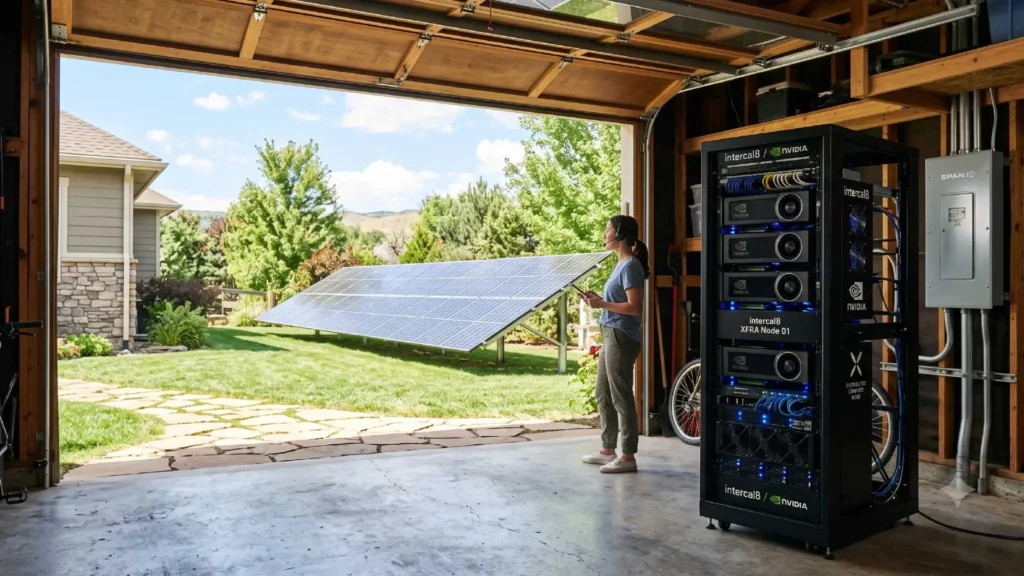
Ahead of the Curve: We Built the Blueprint First
While it’s validating to see tech titans like NVIDIA and SPAN.IO validate this decentralized, energy-smart architecture, the truth is? We saw this shift coming first.
A few months before NVIDIA and SPAN.IO announced their partnership to the world, we had already introduced and published our own solution to this exact problem: our distributed data center management platform, powered by our brand intercal8.
Through our innovative intercal8 diversion load controllers, we pioneered the framework for localizing compute power where energy is already abundant. While the rest of the industry was worrying about grid capacity, we engineered a way to take a massive grid liability—like solar over-provisioning—and transform it into a highly profitable financial revenue stream by powering distributed workloads right at the source.
Seeing the world’s largest chipmaker team up with a smart-panel giant to execute a nearly identical philosophy isn’t just a coincidence—it’s ultimate market validation for what we’ve been building at intercal8.

The Monolith is Dead. The Future is Distributed.
The synergy here connects perfectly back to our core thesis: Centralization is vulnerability. When we concentrate our manufacturing or our computing infrastructure into single, massive hubs tied to a fragile national grid, we invite disaster.
The defense against grid instability is a decentralized footprint. By distributing workloads across independent, localized edge nodes equipped with smart panels, battery backups, and advanced diversion load controllers, the system bypasses central bottlenecks entirely.
As we noted in our blackout piece, “Energy independence is no longer a lifestyle choice, it is industrial strategy.” Whether you are a manufacturer securing your assembly lines against a multi-million-dollar outage or a tech pioneer scaling the next generation of AI, the old playbook is officially obsolete. The age of the vulnerable monolith is dead. The future belongs to the distributed network.
#GridResilience #DistributedDataCenters #EnergyIndependence #CleanTech #AIInfrastructure #Manufacturing #SolarEnergy #InnovationLeaders #Intercal8 #CratusTechnology

Written by
Founder and CEO, CRATUS Technology, Inc.
Zeki founded CRATUS in 2013 and leads the San Jose team building LiDAR volume measurement systems, IoT sensing platforms, and energy and industrial automation hardware.
Full profileLinkedIn


Interested ?
We would be pleased to send you detailed information about our products or services.
Simply enter your details in the contact form below and we will get in touch with shortly.
CRATUS respects your personal information and keeps it safe. By sending this form, you consent to allow CRATUS to store and process your personal information as stated in our Privacy Policy.