


Lidar Sensors by RoboSense
Digital LiDAR built on proprietary SPAD-SoC and VCSELs
Automotive ADAS, L3+ autonomy, robotics and intelligent transportation
Image-grade 3D perception.
Digital LiDAR, from chip to point cloud
RoboSense delivers digital LiDAR technology built for high quality point cloud perception. Its portfolio spans autonomous driving, robotics and humanoid applications, combining precise 3D sensing with compact digital architecture. From long range automotive perception with EM4 and EMX to wide field robotic sensing with E2, E1R, Airy and Fairy, each platform provides real time environmental data for navigation, obstacle detection, mapping and intelligent decision making.
Proprietary chipsets
SPAD-SoC receivers and VCSEL emitters designed in-house, giving high detection sensitivity while preserving raw information for downstream fusion.
All-condition robustness
Blooming suppression, rain/fog/dust noise filtering and contamination resistance are engineered into the optical and signal path, not bolted on in software.
Bandwidth-friendly
Real-time lossless compression cuts point cloud traffic by up to 60%, so a 2K-class sensor still rides on existing in-vehicle Ethernet.
Products & Solutions
The automotive grade E platform, redesigned for robots: a 120° × 90° field of view, 75 m of reach and 144 structured beams from a flat, flush window with no moving parts.
END MARKETS
Real 192 beams, 300 m range and a 10 Hz frame rate in a 120 × 80 × 30 mm body.
END MARKETS
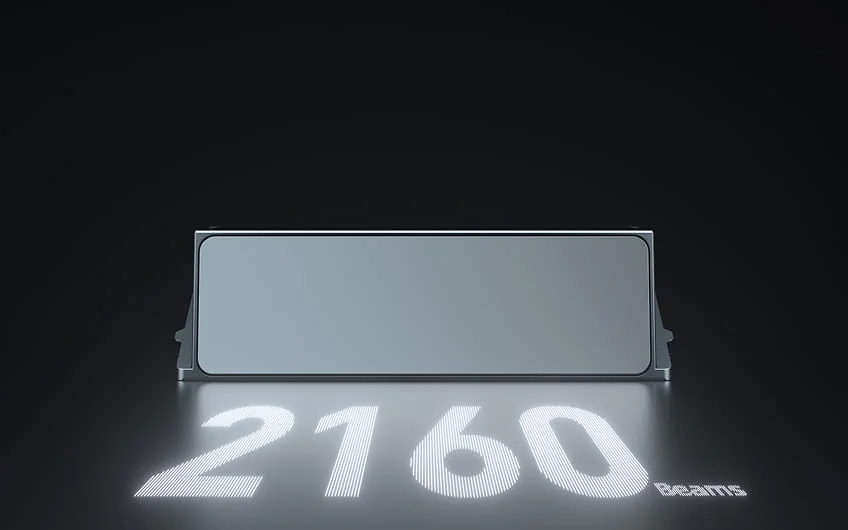
The world’s first “thousand-beam” long-range digital LiDAR, delivering 2K high-definition 3D perception with 2160 beams, a 600 meter detection range and 41.04 million points per second for L3 and above autonomy.
END MARKETS
5 cm precision at up to 150 metres, 96 beams and 1.37 million points per second of point cloud density, in a lightweight lidar weighing under 350 grams.
END MARKETS
A full 360° × 90° hemisphere of perception from a body the size of a ping-pong ball, 1.72 million points per second at 1 cm precision and a dense point cloud using under 8 watts. Ideal for industrial automation and robotics navigation needing 360° perception.
END MARKETS
Solid-state directional flash LiDAR with proprietary chips and a 120° × 90° ultra-wide field of view that scans the near-field blind spot in automotive, robotics and industrial automation applications requiring near-field detection for safety and access monitoring.
END MARKETS
Specification comparison
All figures as published by RoboSense. Where a value is not disclosed for a model it is shown as “—”; ask us for the controlled datasheet.
| Sensor | Scan type | Vertical channels | Horizontal channels | FOV — horizontal | FOV — vertical | Range @10% | Minimum range | Accuracy | Weight | Power | Protection | Temperature range |
|---|---|---|---|---|---|---|---|---|---|---|---|---|
| RoboSenseFairy | Mechanical | 48 | 1440 | 360° | 31.68° | 80 m | ≤0.2 m | 0.5 cm (1σ) | <350 g | <10 W | IP67 / IP6K9K | -40 °C to +60 °C |
| RoboSenseAiry | Mechanical | 96 | 900 @10 Hz | 360° | 90° | 30 m | 0.1 m | 1.5 cm (1σ) | 230 ±20 g | 8 W | IP67 / IP6K9K | -40 °C to +60 °C |
| RoboSenseE1 | Fully solid-state (Flash, 2D electronic) | 144 | 192 | 120° | 90° | 30 m | 0.1 m | ±5 cm (1σ) | 330 ±20 g | <10 W | IP67 / IP6K9K | -40 °C to +85 °C |
| RoboSenseE1R | Solid state | 144-eq | 192 | 120° | 90° | 30 m | 0.1 m | ±5 cm (1σ) | 330 ±20 g | <10 W | IP67 / IP6K9K | -40 °C to +85 °C |
| RoboSenseEM4 | Hybrid solid-state / 1D rotating mirror | 520 (std) / up to 2160 | Up to 1900 | 120° | 27° | ≥250 m | 1 m | ±5 cm | <1000 g | 15 W | IP67 / IP6K9K | -40 °C to +85 °C |
| RoboSenseEMX | Digital scanning | 192 | N/A (0.08° H resolution) | 120° | 20° | 200 m | 1.5 m | ±5 cm (1σ) | 500 ±20 g | 10 W | IP67 / IP6K9K | -40 °C to +85 °C |
Applications
One digital platform serving the full spread of perception workloads.
Robotics
Automotive
Intersection
Highway
Vehicle Overlimit
Rail
Ports
Shipping
Mining
Use cases
Scenarios where digital LiDAR changes the outcome rather than merely adding a sensor.
Highway L3+ autonomy
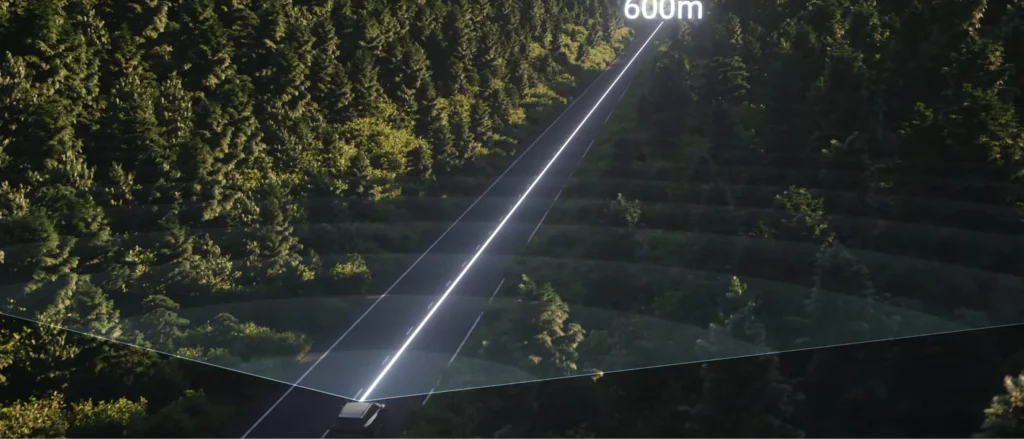
At 600 m of range the vehicle gains up to 70% more response time than a 200 m sensor allows. Stationary hazards, debris and stopped traffic resolve while there is still room to plan rather than react.
Small object detection
Tires, traffic cones and cardboard boxes are the classic failure cases for camera-only stacks. Beam density puts enough returns on a 40 × 25 cm object at distance to classify it, exceeding NHTSA active safety expectations.
Cut-in and projectile response
A 20 Hz frame rate halves perception latency against the 10 Hz industry norm — decisive when an object enters the lane laterally at speed.
Blind spot elimination
A 90° vertical span with a ≤ 15 cm ground blind area covers the kerb, the wheel arch and the space above the door line from a single fixed unit — no rotation, no wear.
Unprotected turns
Cross traffic approaching from either side and the rear is detected with enough margin to abort the manoeuvre, the scenario that most often defeats narrow-FOV sensors.
Humanoid and legged robots
A 180° × 135° field of view from one mounting point covers ahead and both sides at once, while 50 G vibration tolerance survives the impact of every footfall. The 77% smaller exposed window is what allows mounting in a head or wrist.
Slender obstacle detection
Chair legs, cables, wire fencing and plant stems occupy too few angular cells for coarse sensors to hold. At 0.375° resolution and 1 cm precision the E2 keeps thin objects in a real-time track instead of losing them to noise.
Adverse weather operation
Rain, fog and dust returns are filtered by a large echo processing model rather than by a fixed threshold, so genuine returns survive the clean-up that usually removes them too.
What makes it digital
SPAD-SoC and VCSEL, designed in-house
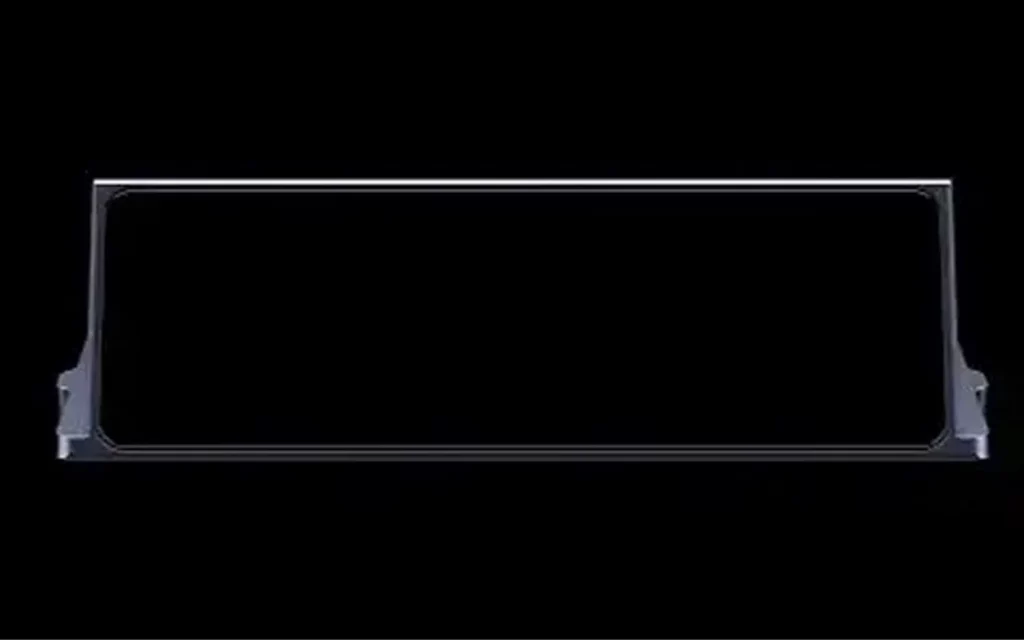
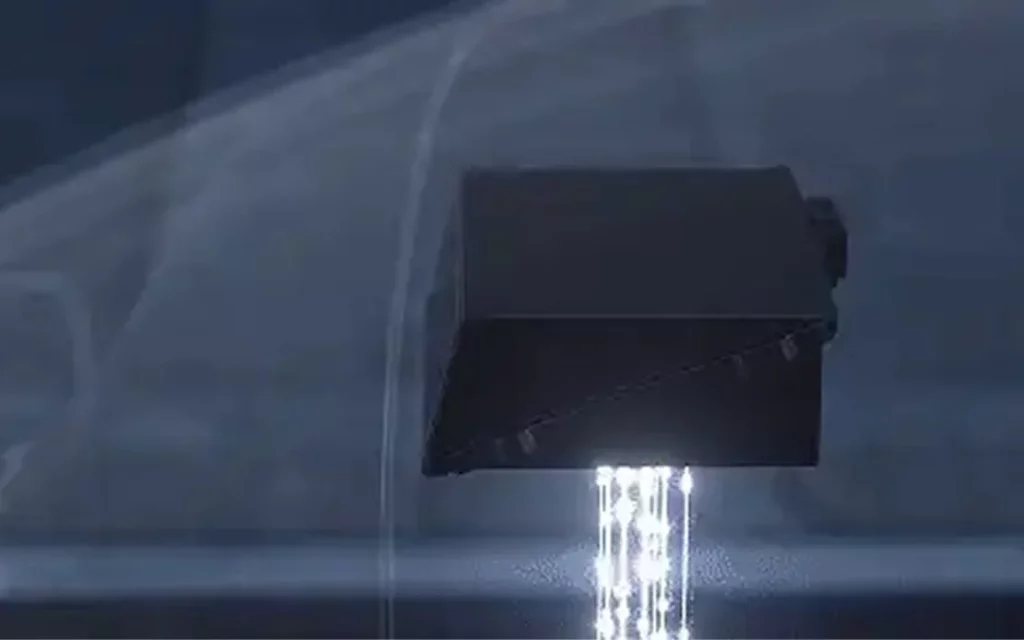
Conventional LiDAR converts the returning photon signal through analogue stages, and each stage costs information. RoboSense integrates a single-photon avalanche diode system-on-chip on the receive side and a VCSEL array on the emit side, so detection happens in the digital domain from the first photon.
The practical consequences are higher sensitivity at long range, immunity to crosstalk between units, and a raw data stream that can be time- and space-synchronised with camera output for genuine sensor fusion.
Lossless compression that respects your bus
A 2160-beam sensor produces gigabits per second of raw point cloud. Real-time lossless compression reduces that by roughly 60%, bringing traffic down to a few hundred megabits — inside the envelope of in-vehicle Ethernet already deployed in production vehicles.
Lossless matters: nothing is discarded to hit the target, so downstream perception sees the same cloud the sensor generated.
Interested ?
We would be pleased to send you detailed information about our products or services.
Simply enter your details in the contact form below and we will get in touch with shortly.
CRATUS respects your personal information and keeps it safe. By sending this form, you consent to allow CRATUS to store and process your personal information as stated in our Privacy Policy.