

Measuring What Matters Using LiDAR for Weight, Volume, and Particle Size in Agriculture, Mining, and Material Handling
When the supply chain is measured in tons and minutes, knowing how much material you have and how it’s changing drives profit and safety. Modern LiDAR brings fast, non-contact measurement of volume, weight (via bulk density), and particle size distribution (PSD) to farms, quarries, mines, and bulk terminals. Below is a practical guide to how it works, where it fits, and how to deploy it with confidence.
Why LiDAR?
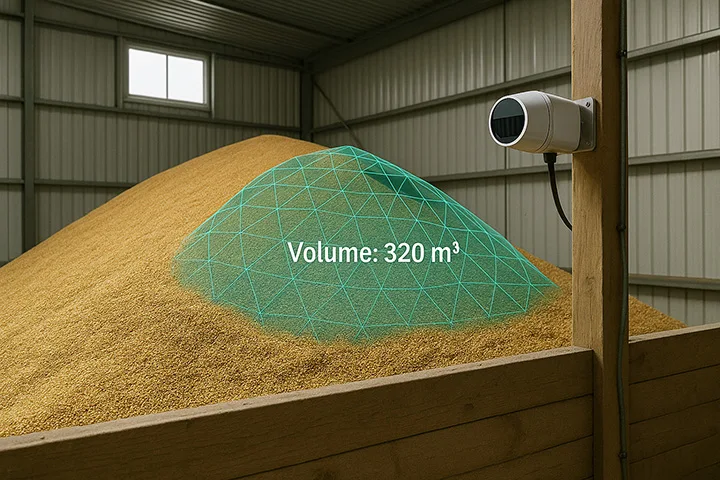
3D accuracy at line speed: High point density enables millimeter or centimeter surface models of stockpiles, truck beds, silage bunkers, grain bins, hoppers, and conveyors.
Non-contact & lighting-agnostic: Works in darkness and varying light; multi-echo returns help in dust or chaff.
Real-time analytics at the edge: Pair sensors with embedded CPUs/GPUs to compute volumes, rates, and PSD on-site.
Core Measurements
1) Volume
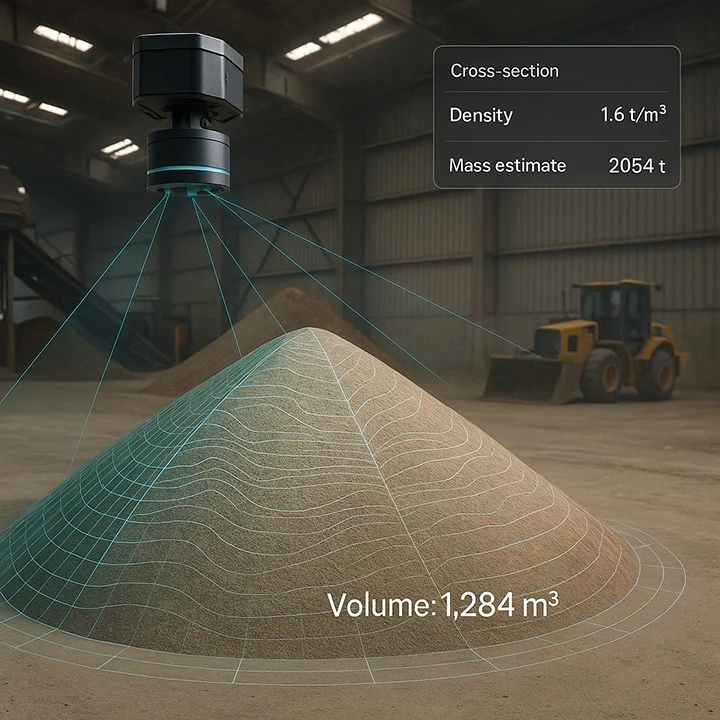
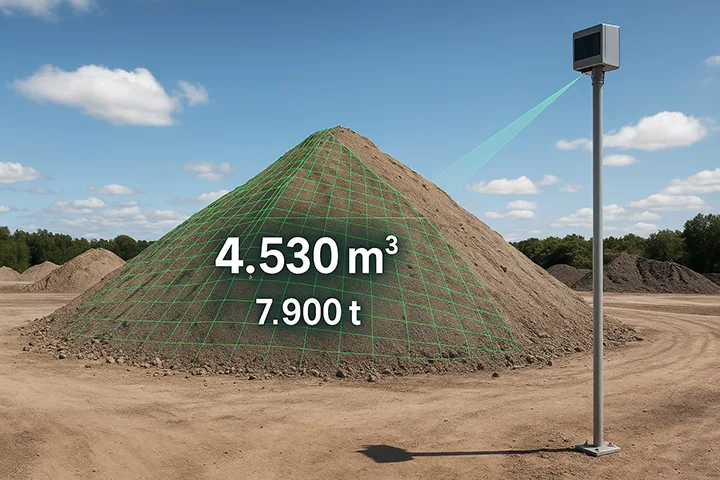
Create a 3D surface (mesh) from the point cloud and compute volume relative to a reference plane or baseline mesh (empty-bin model).
Stockpiles / Bunkers: Mesh-to-plane or mesh-to-mesh comparison.
Bins / Silos: Use a CAD baseline of the vessel; LiDAR scans provide infill height and surface shape.
Trucks / Railcars: Scan loaded profile versus known tare geometry for fast load checks.
Formula (conceptual):
V ≈ ∑ (signed tetrahedra between surface mesh and reference)
2) Weight (Mass)
Convert volume to mass using bulk density:
Mass (t) = V (m³) × ρ_bulk (t/m³)
Adjust 𝝆bulk for moisture, compaction, and particle size.
Improve accuracy by periodically calibrating against belt scales, truck scales, or weighbridges.
3) Particle Size Distribution (PSD)
For PSD on conveyors or in chutes:
Acquire dense scans over the belt section.
Pre-process (denoise, ground/belt removal, normal estimation).
Segment individual particles (region growing/watershed on the depth map or 3D-connected components).
Fit per-particle size metrics (Feret diameters, equivalent circle/volume).
Aggregate to percent-passing curve; report D10/D50/D90 or D32 (Sauter mean).
In particle size distribution, D10 is the particle size value below which 10% of the particles in a sample are found. It’s a percentile that helps define the fine end of the particle size range, indicating the quantity of ultrafine particles present in a powder or sample. The D10 value is typically measured in micrometers (μm).
What D10 represents:
The fine particle threshold: It marks the size of the smallest particles in the distribution.
A percentile: Along with D50 (the median size) and D90 (the size below which 90% of particles fall), D10 provides a comprehensive overview of the particle size distribution.
A measure of consistency: When considered with other percentiles, D10 helps to understnd the spread or consistency of the particle sizes in a sample.
Why it’s important:
Product quality:
Knowing the D10 value can be crucial for industries like pharmaceuticals, where it can affect drug effectiveness.
Industrial processes:
Particle size directly relates to industrial process performance, energy consumption, and product quality.
Notes:
Correct for occlusions and edge bias; use multi-frame fusion to “see around” overlaps.
Validate periodically with sieve analyses to maintain traceability.
Where LiDAR Adds Immediate Value
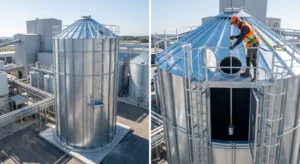
Grain bins & silos in agriculture
Continuous fill-level and volume.
Silage & feed bunkers: Pile volume tracking for ratio planning and shrink loss auditing.
Harvest logistics: Truck/load volume verification at the field edge; reduce under/overloads.
Stockpile Reconciliation in Mining & Quarrying
Frequent, safe 3D scans without walking the pile; monthly to hourly cadence.
Blast optimization feedback: Conveyor PSD after crushing/screening to tune blast and crusher settings.
Haulage verification: Rapid volumetric checks reduce overfill fines and optimize cycle times.
Conveyor Mass Flow Material Handling & Terminals
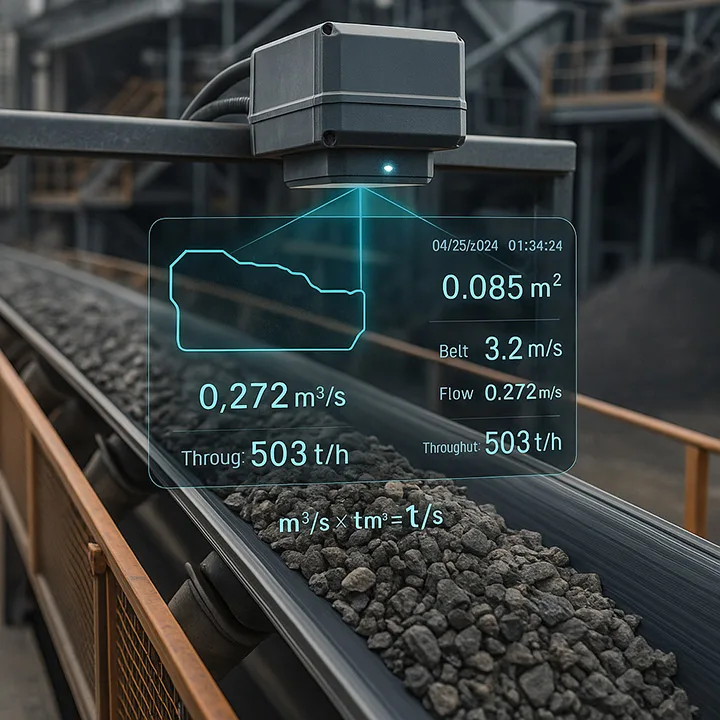
Cross-sectional area from LiDAR × belt speed × bulk density ⇒ tonnage rate.
Hopper/chute monitoring: Detect hang-ups, rat-holing, or asymmetric discharge.
Barge/railcar loading: Live 3D load profiles for even distribution and draft targets.
Deployment Blueprint
1) Sensor Placement
Overhead for conveyors and bins; mast or catwalk positions for piles.
Minimize occlusions; ensure safe mounting outside moving machinery envelopes.
Choose wavelength/optics for range and dust (905 nm vs 1550 nm; consider protective windows and air purge).
2) Sensor Specs to Match the Job
Range: Short (≤20 m) for conveyors; mid (20–80 m) for bins; long (80–300 m) for large piles.
Angular resolution / scan rate: Higher density for PSD; moderate density for volume-only.
FOV: Ensure complete coverage of belt width or pile footprint.
Ruggedness: IP65/67+, shock/vibration ratings, heating for cold starts.
3) Edge Compute + Software
Embedded CPU/GPU for on-site meshing, segmentation, and analytics.
I/O & Protocols: OPC-UA, Modbus/TCP, EtherNet/IP, REST/MQTT for SCADA/MES/EMS integration.
Data Products:
Volume, mass, tonnage rate
PSD curve (tables + plots)
Alarms (overfill, underfill, blockage)
Audit trail with timestamps, operator, and configuration hash.
4) Calibration & QA
Establish golden runs against scales and sieve stacks.
Track bulk density vs. moisture; maintain a density lookup by material and condition.
Schedule routine sensor health checks (window cleaning, laser power/temperature logs).
Accuracy & Throughput Tips
- Use multi-echo and temporal averaging in dusty lines.
- For PSD, maintain belt speed compensation and motion synchronization with encoder signals.
- For large piles, adopt scan path planning or multi-sensor fusion to eliminate blind spots.
- Maintain versioned algorithms and store raw data for reprocessing if contracts/audits require it.
Example Workflows
A) Conveyor Tonnage + PSD (Mining)
- Ceiling-mounted LiDAR scans 1 m of belt.
- Compute cross-sectional area; multiply by belt speed for m³/s → mass flow via 𝜌bulk
- Parallel pipeline segments particles in the upper surface for PSD; output D10/D50/D90 each minute.
- Push KPIs to SCADA and notify when PSD drifts beyond spec.
B) Silo Inventory (Agriculture)
- A top-mounted LiDAR sweeps the surface; compare to silo CAD baseline.
- Output net volume and mass with moisture-adjusted density curve.
- Trigger purchase orders when projected days-of-supply drop below target.
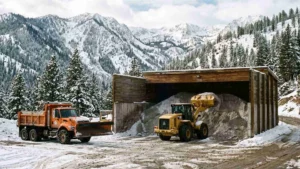
C) Stockpile Reconciliation (Terminals)
- Tripod or fixed-mast LiDAR performs 360° scans hourly.
- Mesh differencing quantifies inflows/outflows; reconciles with weighbridge totals.
- Automated report with variance, confidence bands, and photo thumbnails.
Quantifiable ROI
- Shrink reduction (agri): less guesswork on pile/bunker losses.
- Reduced rework/fines (mining/terminals): fewer overloads and better distribution.
- Energy savings: PSD control stabilizes mill/crusher performance.
- Labor & safety: No climbing piles or entering confined spaces for manual dip measurements.
Getting Started: A Short Checklist
- Define required metrics (volume only vs. volume + PSD).
- Map ranges, FOV, and occlusions; pick sensor mounts.
- Decide edge compute footprint (CPU vs. GPU) and protocols to SCADA.
- Establish density & PSD calibration plan.
- Pilot on a single conveyor/bin; validate against scales/sieves; then scale.
Want a turnkey path?
We can deliver LiDAR + embedded compute bundles preloaded with volume, mass, and PSD analytics—plus industrial I/O for drop-in integration.

Written by
Founder and CEO, CRATUS Technology, Inc.
Zeki founded CRATUS in 2013 and leads the San Jose team building LiDAR volume measurement systems, IoT sensing platforms, and energy and industrial automation hardware.
Full profileLinkedIn
Interested ?
We would be pleased to send you detailed information about our products or services.
Simply enter your details in the contact form below and we will get in touch with shortly.
CRATUS respects your personal information and keeps it safe. By sending this form, you consent to allow CRATUS to store and process your personal information as stated in our Privacy Policy.