

Characterized in our LiDAR materials lab
Bulk density, particle size, moisture behavior, angle of repose. The result is a density model for your material that LiDAR weight estimation uses on every measurement.
A static density number on a spec sheet will lose you money on a real site. Here is how CRATUS turns LiDAR volume measurement into audit-ready weight estimation with environmental compensation and confidence intervals.
LiDAR measures volume directly. Weight is a different problem. CRATUS treats LiDAR weight estimation as a science problem, not a multiplication.
Bulk density, particle size, moisture behavior, angle of repose. The result is a density model for your material that LiDAR weight estimation uses on every measurement.
Humidity, temperature, rainfall, pile shape, time since last addition. Live inputs feed the LiDAR weight model alongside the volume measurement.
New supplier, new season, new product line? Re-characterize once and the LiDAR platform adjusts. Historical data stays comparable.
Weight estimation accuracy increases for every material by providing feedback to the models. Audit-ready by design.
When weight numbers are wrong, the damage propagates through billing, inventory, audit, and operations. LiDAR-based weight estimation with characterized density closes the gap.
A 5% density error on 50,000 tons a month is real money. LiDAR weight estimation with calibrated density closes the gap on every truck.
When in-yard weight is off by 10%, working capital is wrong by the same amount. LiDAR volume measurement replaces the assumption with data.
When shipped and received numbers do not match, the argument is whose scale was wrong. Same LiDAR weight model on both ends removes it.
Static density lies about weather and season. LiDAR weight estimation with environmental compensation shrinks the buffers your business carries.
A confidence interval and a documented density model are what auditors want to see. LiDAR measurements get timestamped and stored on the edge.
Pharma and CPG dose by mass. Drifting density assumptions cause scrap, rework, or recall. LiDAR bin weight removes the drift.
We sell engineering services as much as we sell LiDAR hardware.
We characterize your material and review your site. Output: LiDAR feasibility report and fixed-price quote.
Sensor placement, edge unit location, integration points. Output: LiDAR region of interest (ROI) drawing and bill of materials.
We install, commission, and tune the LiDAR system with comparisons to your existing measurement system, if there is one in place. Output: live LiDAR measurements.
LiDAR data lands in your ERP, MES, historian, SCADA. Output: fully integrated production LiDAR measurement system.
Hardware purchase + optional cloud subscription. Remote LiDAR point cloud and measurement accuracy monitoring, updates, and continuous characterization until peak accuracy is reached.
CRATUS LiDAR systems feed your existing ERP, MES, SCADA, and BI tools through standard industrial and IT protocols.
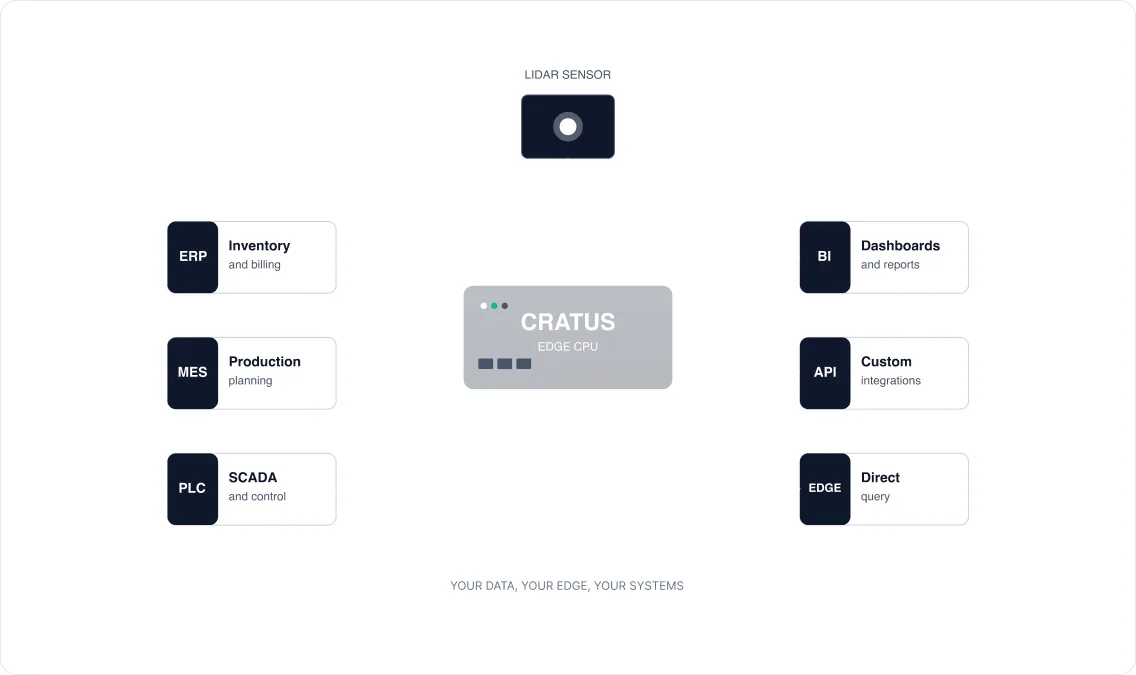
The cloud is optional. LiDAR data flow runs from your edge CPU to your systems. Our cloud platform is available when you want multi-site rollup, multi-user access, and managed support.
Full answers live in the LiDAR reference manual we send to evaluating customers.
Two to four weeks from first call to a LiDAR deployment design and fixed-price quote.
Interested ?
We would be pleased to send you detailed information about our products or services.
Simply enter your details in the contact form below and we will get in touch with shortly.
CRATUS respects your personal information and keeps it safe. By sending this form, you consent to allow CRATUS to store and process your personal information as stated in our Privacy Policy.
GET IN TOUCH
One of our experts will be communicating with you shortly. We are committed to understanding your application and providing support, tailored to your specific requirements.