


Written by
Founder and CEO, CRATUS Technology, Inc.
Zeki founded CRATUS in 2013 and leads the San Jose team building LiDAR volume measurement systems, IoT sensing platforms, and energy and industrial automation hardware.
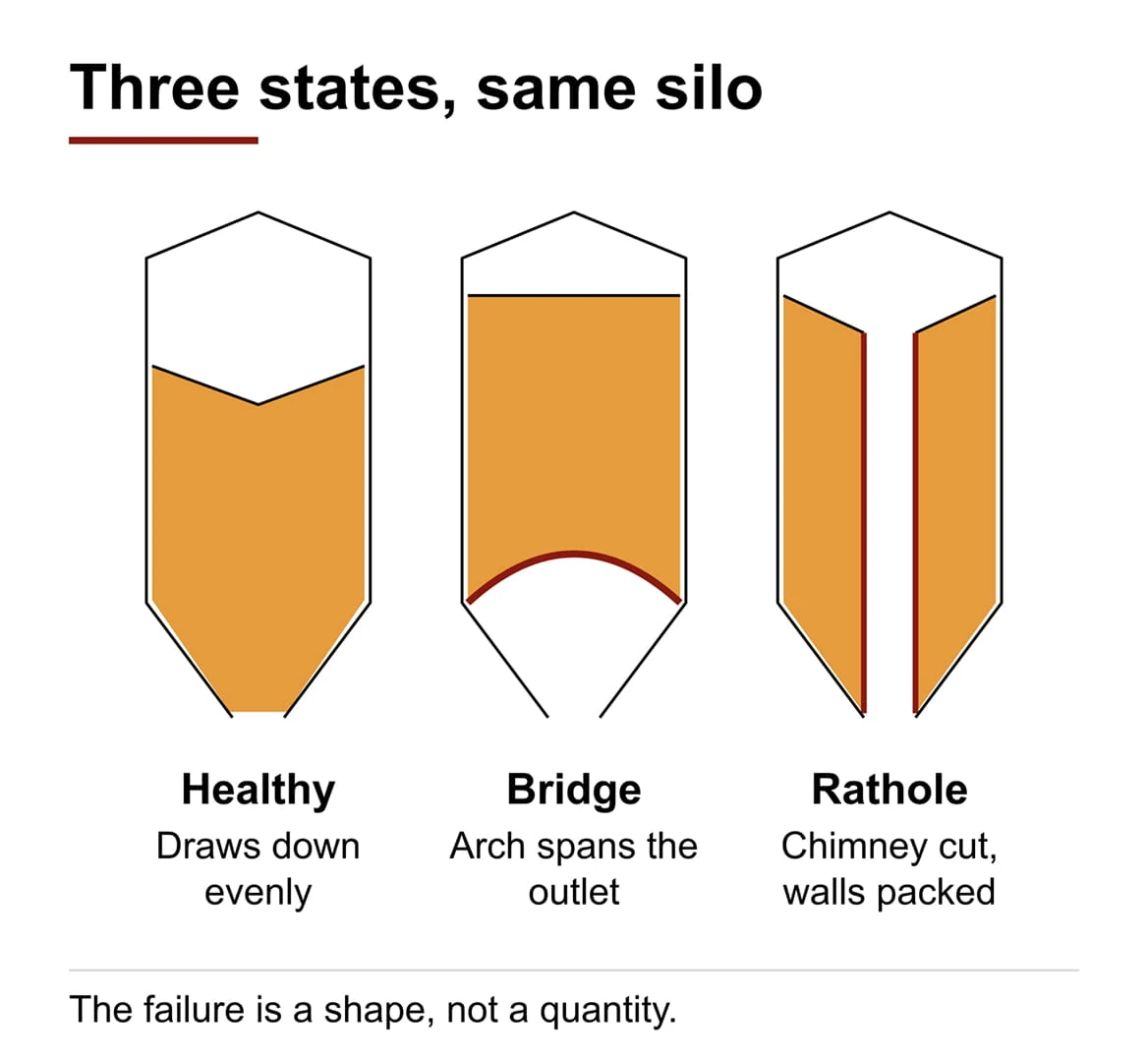
Full profileLinkedInHere is the first one. The silo is full, the feeder is running, and nothing is coming out. Somewhere above the outlet the material has formed a stable arch across the opening, strong enough to carry its own weight, and the entire column above it is now standing on that arch instead of feeding the discharge. The second is worse, because it lies in the opposite direction. The material bores a narrow channel straight down the middle and empties through it, leaving the rest standing against the walls where it slowly hardens. Your level reading falls toward empty. Most of what you are storing never moved.
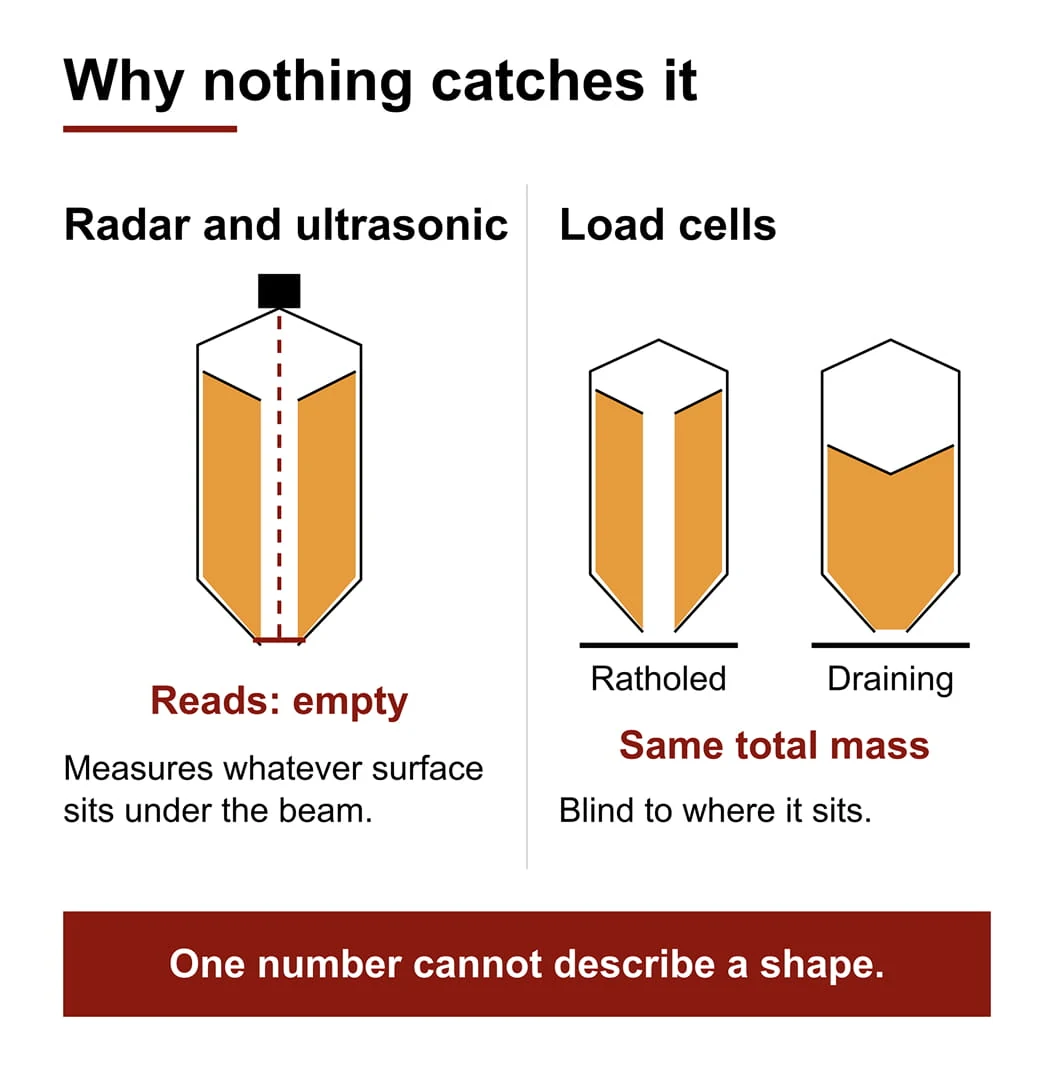
Neither of these shows up on anything you already have installed, and the reason deserves precision, because it is not a quality problem with your instruments. A radar or ultrasonic gauge measures the distance to whatever surface sits under its beam. During a rathole that surface is the floor of the chimney, so the gauge reports a silo running empty while the perimeter is still packed. Load cells look like they ought to catch it, and they do not. A load cell gives you total mass and says nothing whatsoever about where that mass is sitting, so a ratholed silo and a properly draining one holding the same tonnage read identically. Every instrument in that list returns a single number, and what has gone wrong is a shape. One number cannot describe a shape.
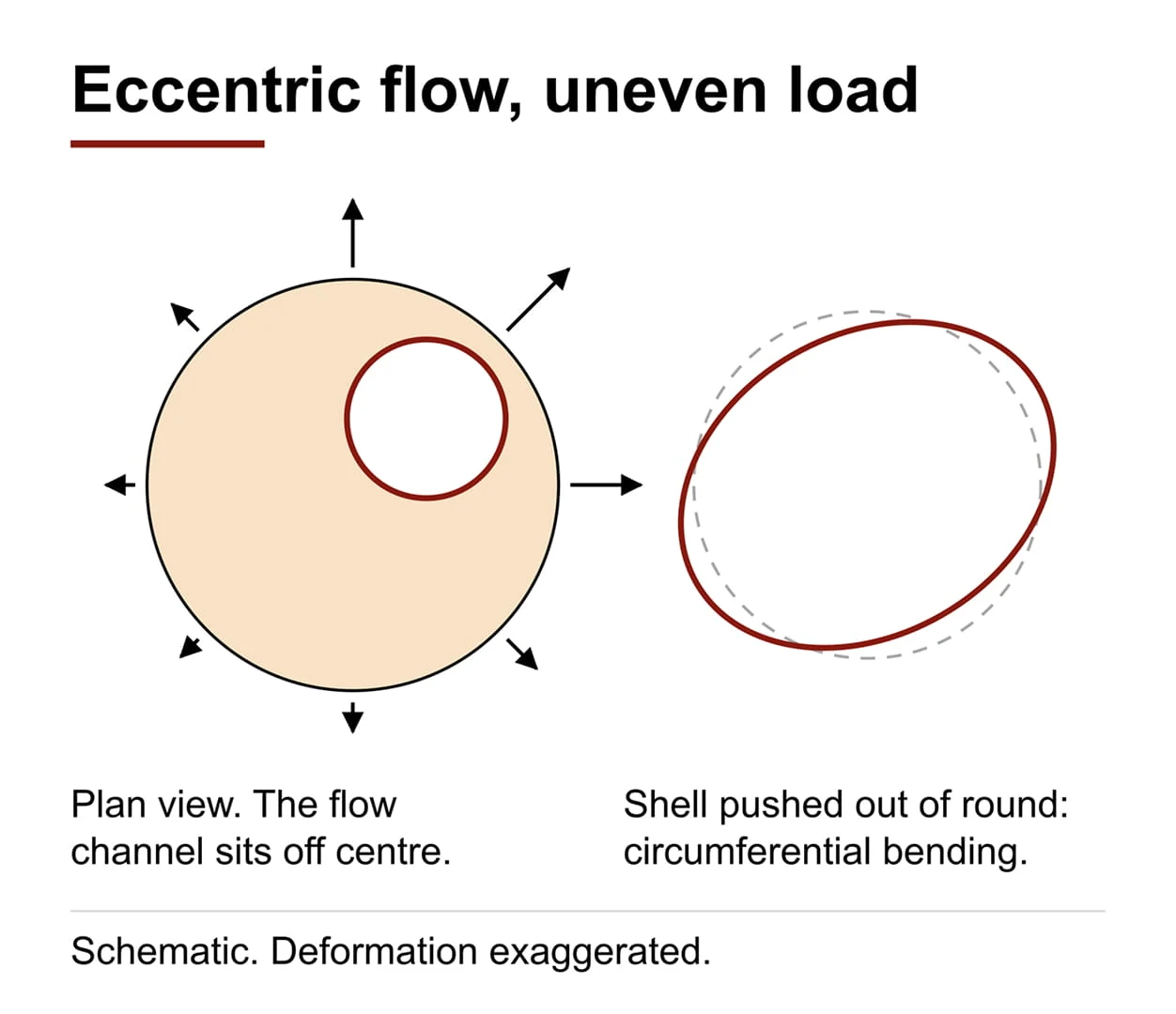
Which means the first you hear about it is when production stops, or when somebody climbs up and looks. That is the point where the cost stops being about material. Clearing an arch, or breaking down material caked on the wall, means going in with a pole, and it gets scheduled blind because nobody can see whether it is necessary. Meanwhile the structure itself is paying. Jenike and Johanson, who have worked on this problem since the 1960s, are blunt about it: eccentric discharge develops non-uniform pressures around the circumference, “leading to circumferential bending and axial compression on the cylinder shell.” In thin metal silos that produces high membrane stresses which “may deform the shell and in some cases cause catastrophic failure.” In concrete it produces bending moments and serious cracking. Then they add the line that should keep an engineer awake, that the non-catastrophic failures “may be the prelude to a much larger event in the near future.”
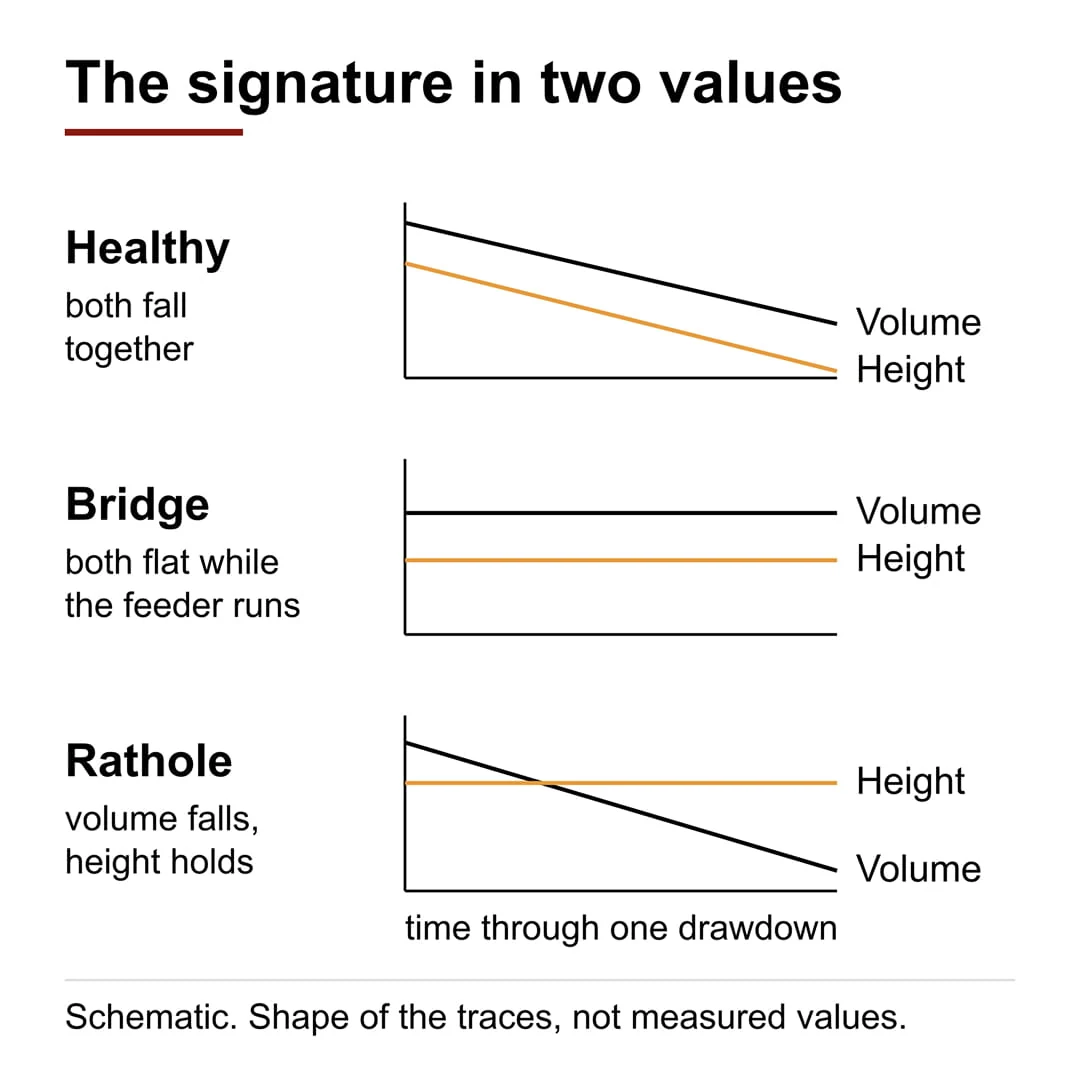
What actually reads both failures is the shape of the surface, and it turns out you need only two values off it to get the whole story: how much material is in there, and how tall the highest point is. Watch those two together through a drawdown and each failure signs its own name. Healthy discharge, both fall. An arch, both go flat while the feeder keeps running. A rathole, volume drops away while peak height sits exactly where it was, because the walls are holding it up. Two numbers moving against each other, and you know which problem you have well before anything downstream starves.
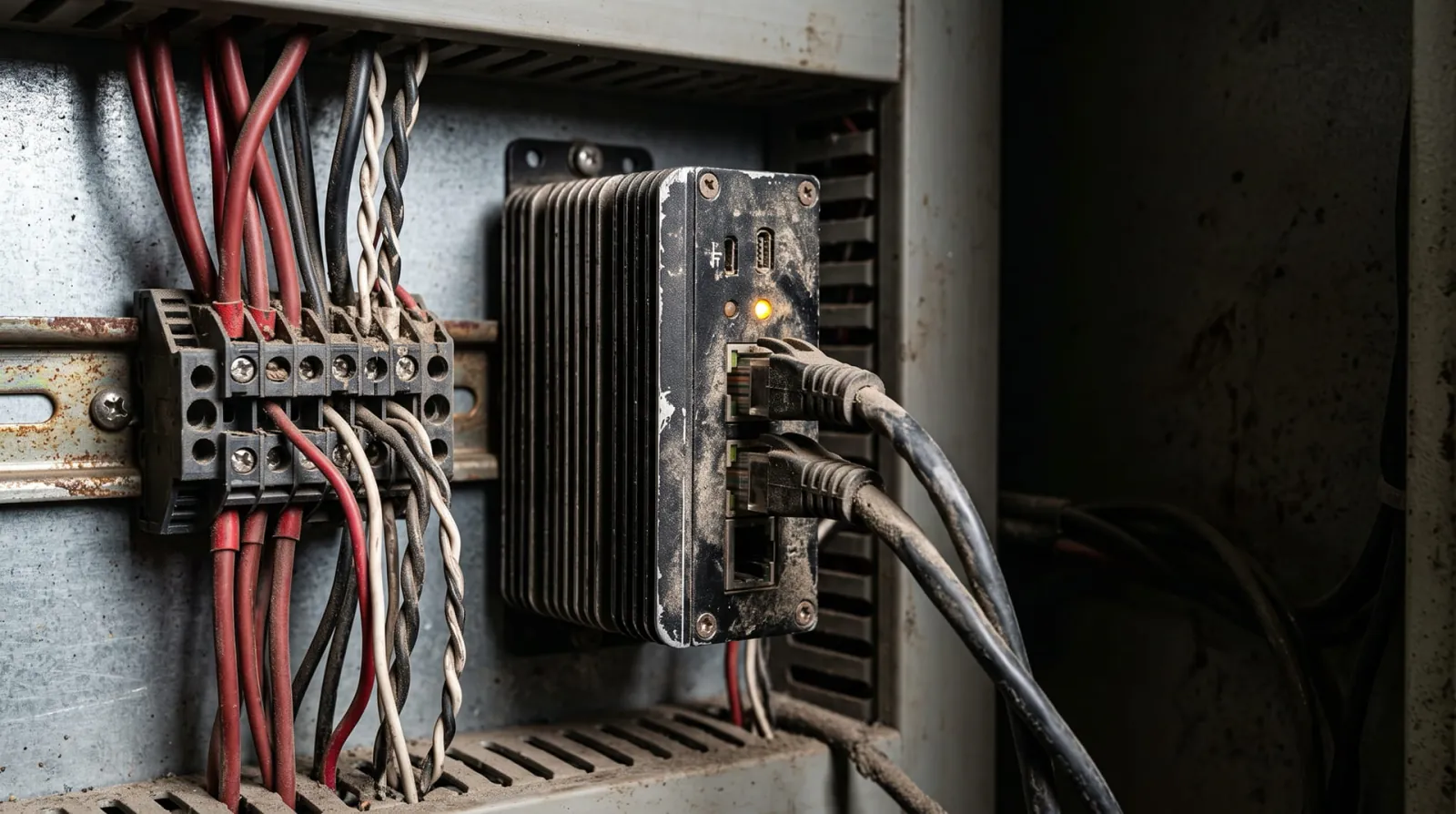
The CRATUS VMS-HS128 publishes both of them. LiDAR sensors mounted in the roof space scan the full surface on a schedule, and the compute unit puts volume in cubic meters and peak pile height in meters straight into your SCADA over Modbus TCP, as two ordinary registers. That detail matters more than it sounds, because the diagnostic above is not something you have to buy from us or wait for a release to get. Your own integrator can historize those two tags and write the divergence alarm in an afternoon, inside the control system you already run. Everything else the system does, inventory that is current rather than remembered and a reason to stop opening the roof, is worth having on its own. But the first time it tells you an arch is forming while the silo still reads full, it has paid for itself.
Zeki founded CRATUS in 2013 and leads the San Jose team building LiDAR volume measurement systems, IoT sensing platforms, and energy and industrial automation hardware.
Full profileLinkedInShare
Interested?

Interested ?
We would be pleased to send you detailed information about our products or services.
Simply enter your details in the contact form below and we will get in touch with shortly.
CRATUS respects your personal information and keeps it safe. By sending this form, you consent to allow CRATUS to store and process your personal information as stated in our Privacy Policy.
GET IN TOUCH
One of our experts will be communicating with you shortly. We are committed to understanding your application and providing support, tailored to your specific requirements.