

Beyond the Flat Plane:
Why 3D Safety-Rated LiDAR Changes the Game
Standard 2D safety laser scanners protect planar slices along floors or walls, but industrial hazards operate in three dimensions. Certified 3D safety-rated LiDAR extends protection beyond a flat scanning plane by monitoring volumetric areas around active machinery.
3D safety-rated LiDAR is a safety sensing technology that monitors hazards across three-dimensional space, detecting people and objects by height, width, and depth rather than within a single flat scanning plane.
This volumetric approach can help industrial safety systems detect hazards that conventional 2D scanners may not capture, including elevated objects, raised forklift forks, overhanging loads, and movement occurring above or below a fixed scanning plane.
2D Safety Zones vs. 3D Volumetric Protection
| Feature | 2D Safety LiDAR | 3D Safety-Rated LiDAR |
|---|---|---|
| Spatial Field | Single 2D plane or horizontal slice | 3D volumetric field across X, Y, and Z space |
| Hazard Blindspots | May miss overhanging loads, raised forks, and elevated robotic motion | Can monitor hazards across multiple heights within a defined volume |
| Footprint Efficiency | Often requires larger floor-level safety buffers | Can support safety zones that better follow machine and workspace geometry |
| Zone Adaptation | Primarily adjusts perimeter distance based on movement or speed | Can support multi-axis safety zones that adapt to factors such as position, speed, angle, and height |
A 2D safety scanner protects a plane. A 3D safety LiDAR protects a volume.
That distinction becomes increasingly important as factories introduce autonomous vehicles, robotic systems, elevated material handling, and equipment that moves across multiple axes.
Emerging Industrial Use Cases
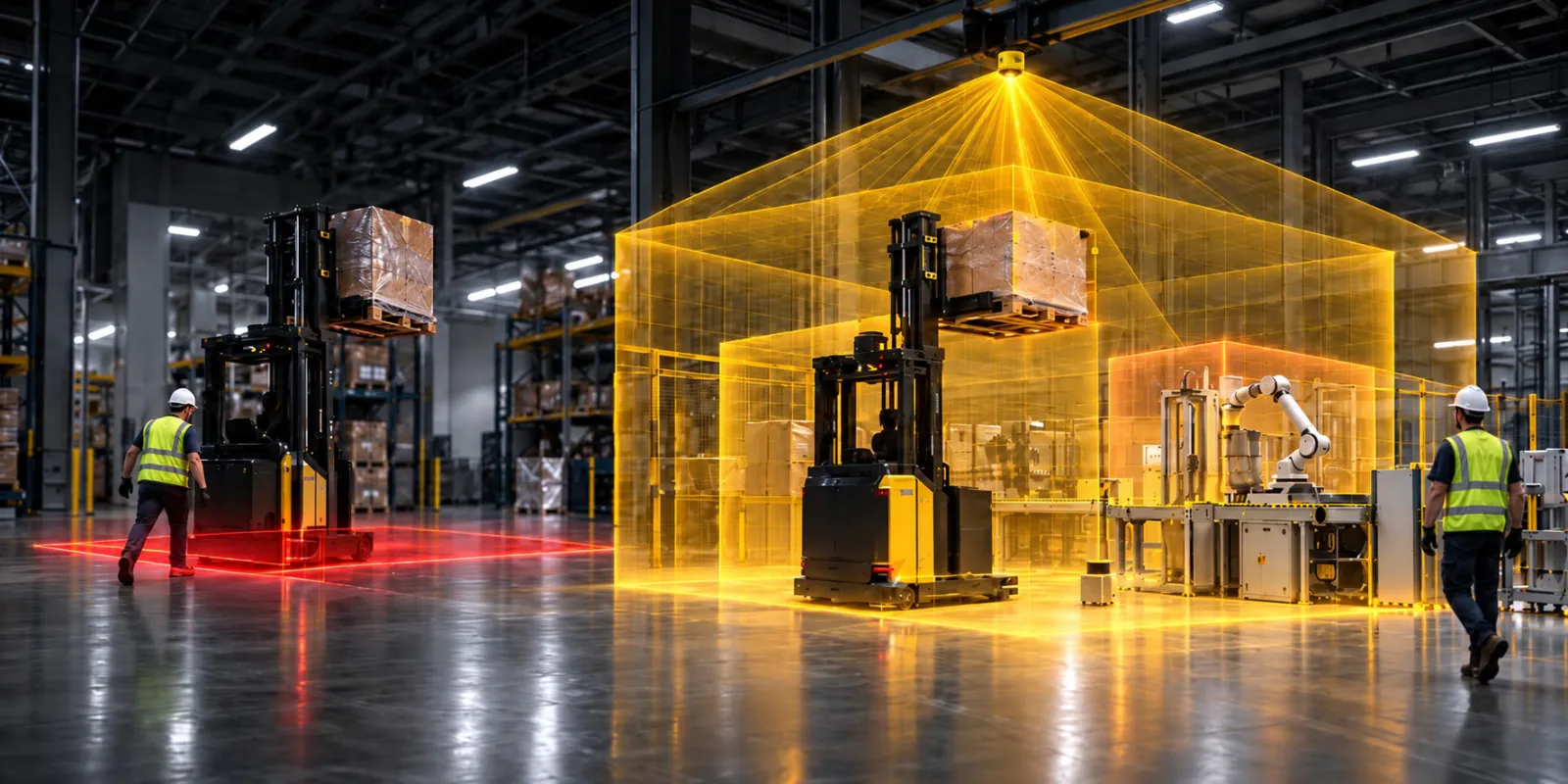
Overhang & Elevated Detection for AMRs and AGVs
Mobile platforms relying primarily on floor-level 2D scanners may remain blind to overhanging rack crossbeams, cantilevered shelf loads, raised forklift tines, or other elevated obstacles.
3D safety LiDAR can monitor a larger portion of the vehicle’s spatial profile, helping identify collision risks that exist above the conventional floor-level detection plane.
In mobile robotics, volumetric safety perception means monitoring not only where the vehicle is going, but also the three-dimensional space the vehicle occupies while moving.
Cobot Speed and Separation Monitoring
Collaborative robotic applications increasingly depend on safety systems that understand how workers and robot arms move relative to one another.
3D safety sensing can support volumetric protective regions around robotic workspaces. Instead of treating the entire robot cell as a single fixed perimeter, safety zones can be designed around the position and movement of people and machinery.
This can be valuable for applications involving speed and separation monitoring, where the relative distance between a person and hazardous robot motion must be continuously evaluated within the overall safety system.
High-Bay Palletizing and Material Handling
Walk-in robotic palletizing cells traditionally rely on combinations of fencing, light curtains, scanners, and access controls.
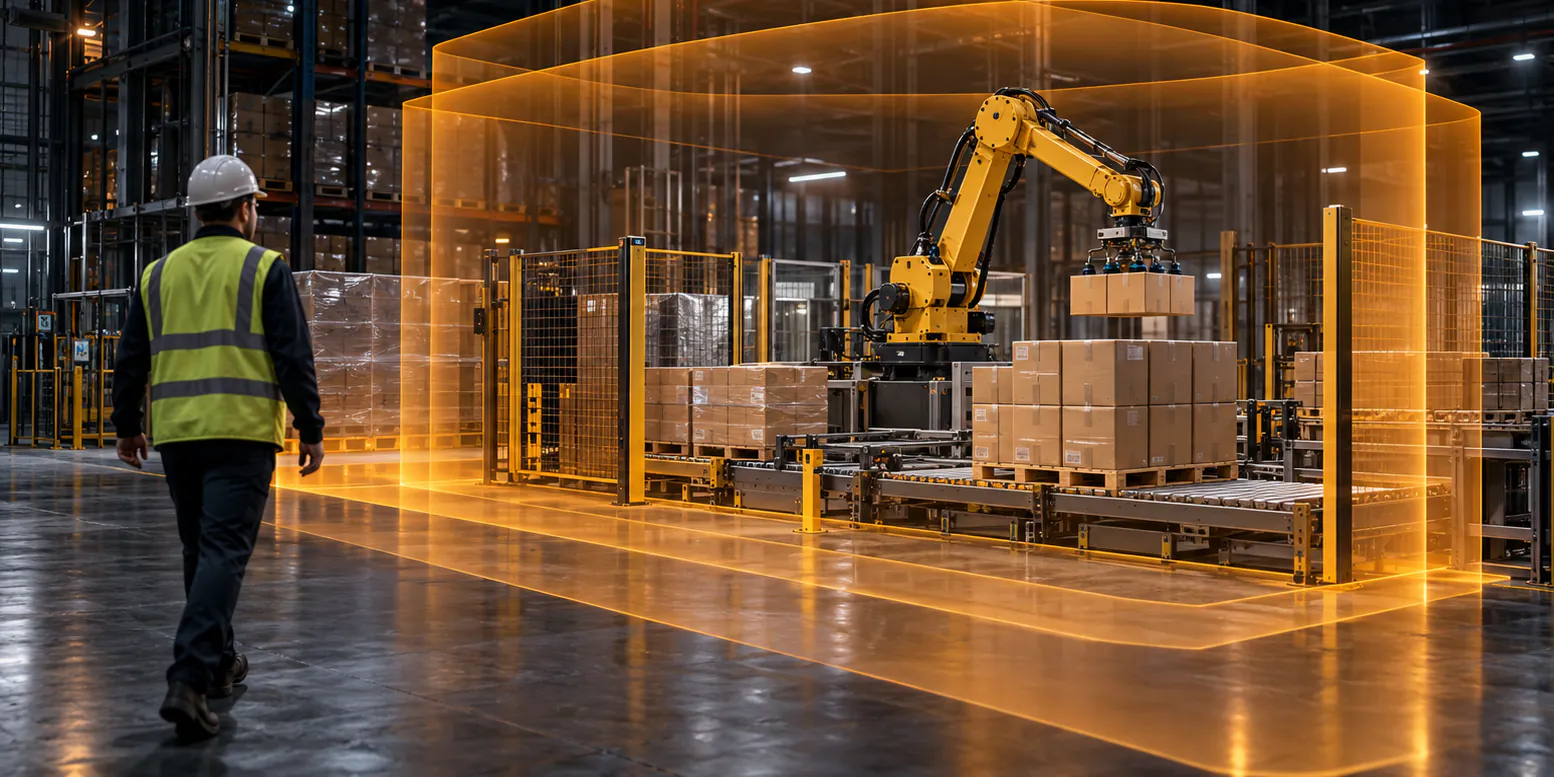
Depending on the installation, an overhead 3D safety LiDAR can monitor both horizontal and vertical areas within the workspace, helping detect human intrusion while allowing normal material flow to continue.
Volumetric safety monitoring allows a sensing system to observe a defined three-dimensional protected space rather than only its perimeter or a single horizontal slice.
Cliff Detection and Drop-Off Protection
3D LiDAR can also provide awareness of environmental changes across both horizontal and vertical axes.
For mobile equipment, this may include detecting elevated obstacles while also identifying changes in ground geometry such as loading dock edges, ramps, pits, or other drop-off hazards, depending on sensor placement and system configuration.
Why 3D Safety-Rated LiDAR Matters
Deploying 3D volumetric perception expands safety engineering beyond conventional two-dimensional perimeter guarding.
As industrial environments move toward higher throughput, increased automation, and denser floor plans, flat safety zones can become restrictive or leave certain parts of the environment outside the monitored plane.
The key advantage of 3D safety-rated LiDAR is its ability to define and monitor safety zones that reflect the actual three-dimensional geometry of people, machines, and industrial environments.
This gives system designers greater flexibility when protecting complex machinery, autonomous systems, and dynamic production environments.
Frequently Asked Questions About 3D Safety-Rated LiDAR
What is 3D safety-rated LiDAR?
3D safety-rated LiDAR is a LiDAR-based sensing technology designed for safety applications that monitors a three-dimensional volume rather than a single two-dimensional scanning plane. It can detect people and objects across horizontal, vertical, and depth dimensions within a defined safety area.
What is the difference between 2D and 3D safety LiDAR?
A 2D safety LiDAR monitors a predefined flat scanning plane, typically near floor level. A 3D safety LiDAR monitors a volumetric area, allowing the system to detect hazards at different heights and positions within the environment.
Why use 3D LiDAR for industrial safety?
3D LiDAR can help identify hazards that may exist outside the scanning plane of conventional 2D sensors, including raised forklift forks, overhanging loads, elevated machinery, robotic motion, and people entering complex three-dimensional workspaces.
Can 3D safety LiDAR be used with AMRs, AGVs, and robots?
Yes. Depending on the application and safety architecture, 3D safety LiDAR can be used to monitor volumetric safety zones around mobile robots, autonomous vehicles, robotic cells, and collaborative workspaces.
Where is 3D safety-rated LiDAR most useful?
3D safety-rated LiDAR can be particularly useful in manufacturing, warehousing, logistics, material handling, robotics, palletizing, loading areas, and other industrial environments where hazards extend beyond a single horizontal plane.

Written by
Founder and CEO, CRATUS Technology, Inc.
Zeki founded CRATUS in 2013 and leads the San Jose team building LiDAR volume measurement systems, IoT sensing platforms, and energy and industrial automation hardware.
Full profileLinkedIn
Interested ?
We would be pleased to send you detailed information about our products or services.
Simply enter your details in the contact form below and we will get in touch with shortly.
CRATUS respects your personal information and keeps it safe. By sending this form, you consent to allow CRATUS to store and process your personal information as stated in our Privacy Policy.