One alternative to a belt scale is a non-contact volumetric system: a 3D LiDAR above the belt measures the shape of the load, a speed sensor tracks belt travel, and software turns volume into tonnage with a density value. It does not replace a certified belt scale where the weight is the basis of a sale, but it covers jobs a scale handles poorly, such as load position, surges, fill level and particle size. This guide explains what limits belt scale accuracy, how LiDAR conveyor measurement works, and how to choose.
Other ways to measure bulk material exist, such as weigh feeders, nuclear belt gauges, impact flow meters and weighing trucks or bins at the ends of the line. This guide covers the non-contact LiDAR option because it adds what a scale cannot see.
If you already know you want to measure material on a conveyor without touching it, see our conveyor volume measurement page. If you are still deciding, read on.
What a Belt Scale Does Well
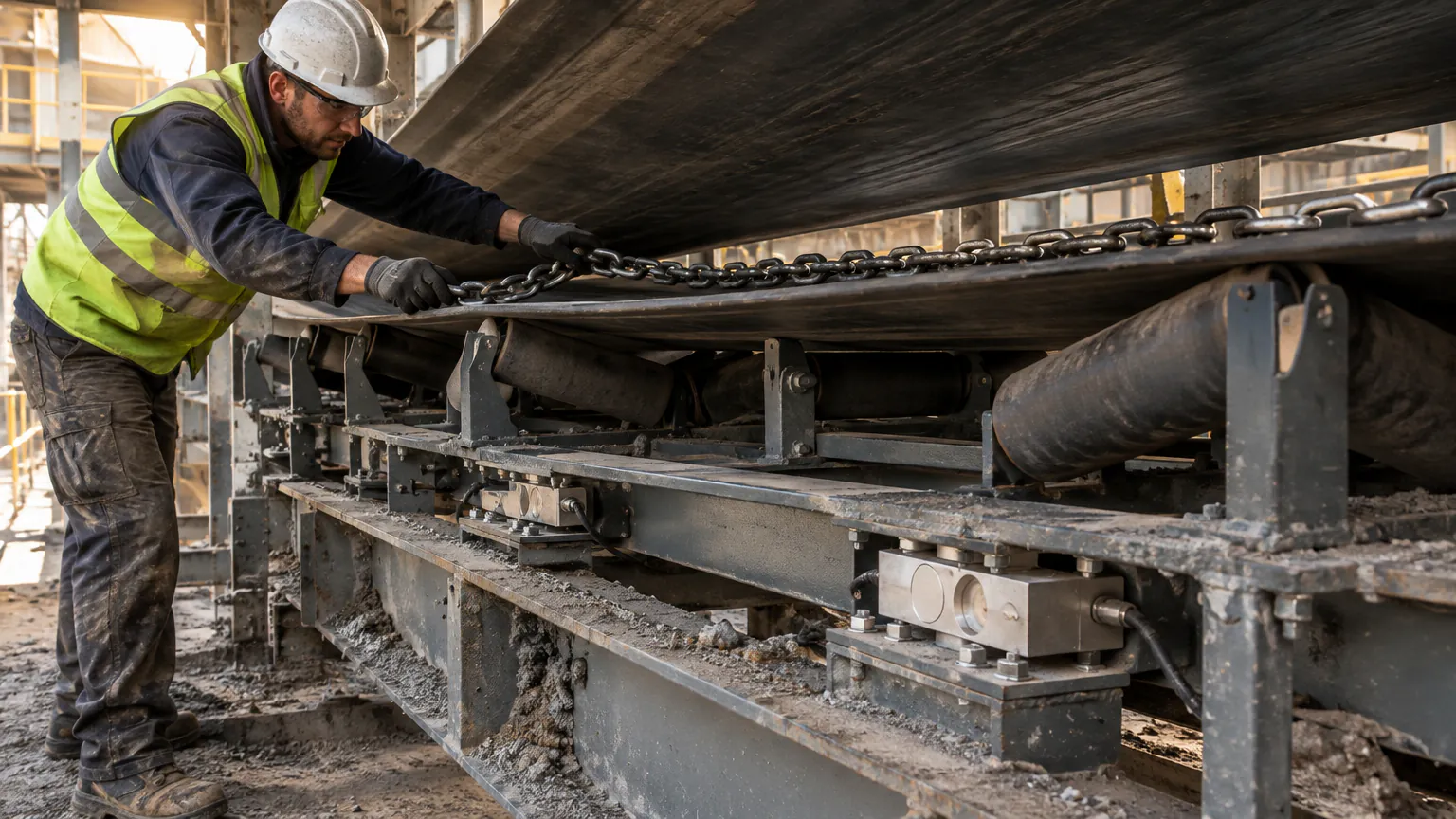
A belt conveyor scale weighs the material on a short section of the belt, which gives the load per meter of belt, and multiplies that by belt travel to get total mass. Manufacturer documentation for belt conveyor scales names two required inputs: the force on the load sensor and the belt travel. The same documentation rates a four-idler, four-load-cell system at about ±0.125% best accuracy, and describes three typical uses:
- Trade or custody transfer: accuracy of ±0.25% or ±0.125% and a certified calibration.
- Process management: between ±0.125% and ±1%, depending on the process.
- Process monitoring: between ±0.5% and ±3%, for a reasonable indication or an alarm.
For certified tonnage, a belt scale is the proven tool. Nothing in this article changes that.
What Limits Belt Scale Accuracy
Belt scales measure force while the belt is moving, so the result depends on the conveyor as much as on the instrument. A belt scale manufacturer’s handbook lists the main factors:
| Factor | What the handbook says |
|---|---|
| Belt speed measurement | A 1% error in belt travel gives a 1% error in the total. Differences of 0.3 to 0.5% have been observed along a conveyor because of belt tension changes. |
| Zero shifts | Shifts of 0.1 to 0.2% of full scale are normal and come from weather changes, material buildup on the weighbridge and belt tracking. A daily zero calibration is recommended. |
| Idler quality and alignment | Idlers in the weigh area must be uniform and aligned. Troughing angles of 35 degrees or less are preferred for high accuracy. |
| Conveyor structure | Deflection between adjacent idlers in the weigh area should not exceed 0.6 mm under load, and there should be no expansion joints in that region. |
| Changing incline | Stacking conveyors and other conveyors that change elevation angle reduce accuracy and need an incline sensor. |
| Calibration method | Only a weighed material test against a reference scale establishes traceable accuracy. Test chains, weights and electronic checks show repeatability, not accuracy. |
None of this is a flaw. It is why belt scales are installed carefully, checked often and calibrated by people who know the conveyor. The handbook also says that most weighing errors result from improper zero calibration and a lack of understanding of what moves the zero.
When a Belt Scale Is the Wrong Fit
A belt scale is hard to apply when:
- The conveyor cannot meet the installation rules. Cable or rope conveyors are not suitable without a rigid section added, and the idlers on both sides of the weigh area must be aligned on any belt.
- You cannot stop the line for material tests and chain checks. Calibration is part of the cost of ownership.
- The question is not about weight. A load cell cannot tell you where material sits across the belt, whether the belt is running well under its design cross-section or whether a surge is building at a transfer chute. Off-center loading is a recognized cause of belt mistracking, and a weigh scale sees the same force whether the load is centered or not. We cover this in A Belt Scale Cannot Tell a Centered Load From One That Is Destroying Your Belt.
- You want to retrofit without touching the idlers. Weigh idlers and carriages replace part of the conveyor. An overhead sensor does not.
How LiDAR Conveyor Measurement Works
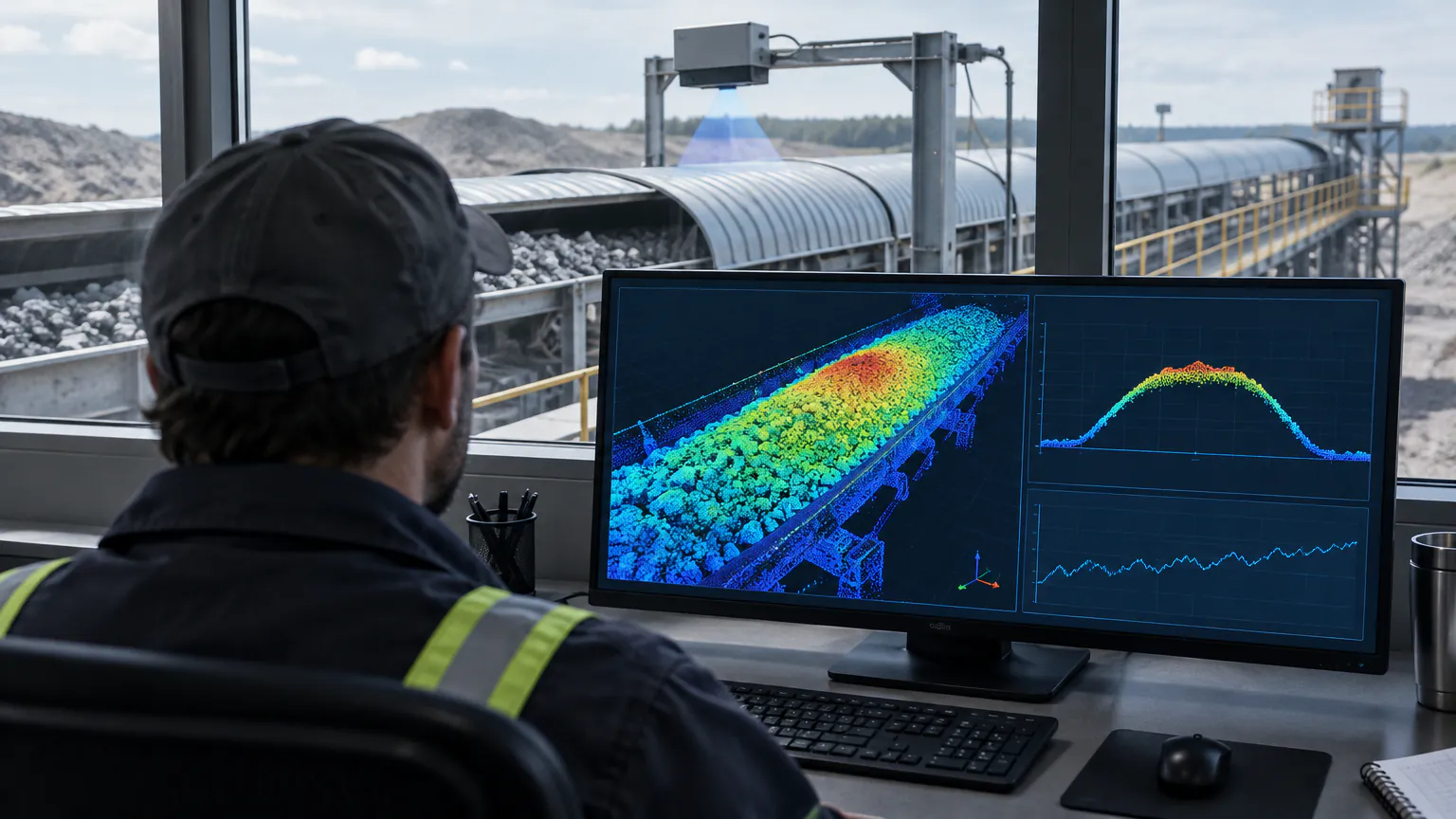
A 3D LiDAR above the belt scans the cross-section of the load many times per second. The system combines each profile with belt travel from a speed sensor, so every scan covers a known length of belt. Cross-section area times belt displacement gives volume. If you know the bulk density of the material, volume becomes mass.
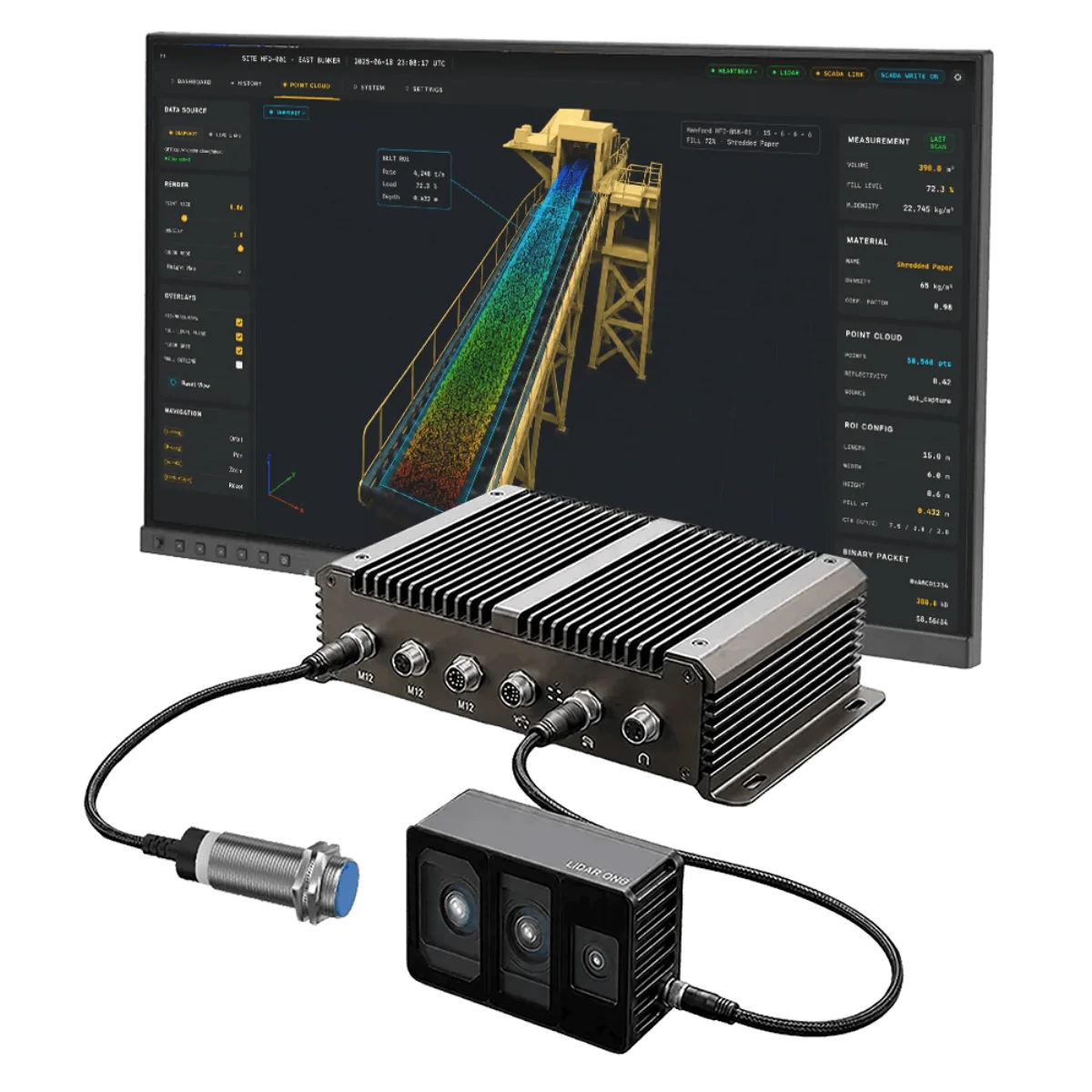
The CRATUS VMS-FL180C and VMS-ME032 conveyor measurement systems work this way. Each uses a LiDAR and camera module over the belt, a conveyor speed sensor and a power connection, so the installation needs three field connections and, as described on the product pages, does not modify the idlers. Because the sensor records the whole profile and a color image, the same data can show where the load sits across the belt and how full the belt cross-section is (the fill level). The product pages also list particle size distribution analysis and colorized images. They describe the systems as non-contact and drift-free, with 99%+ volumetric accuracy; ask us about the conditions behind that figure for your material and belt.
From Volume to Tons
Volume is a direct measurement of the profile, but it still depends on the belt speed signal: a 1% error in belt travel gives a 1% error in volume, as it does for a belt scale. Tonnage is volume times bulk density, so it is only as good as the density you use. Moisture, particle size and compaction all change it. CRATUS uses a density model characterized for your material, as explained on our LiDAR weight estimation page. For a general method, see volume and weight estimation using LiDARs.
Belt Scale and LiDAR Compared
| Belt scale | LiDAR volumetric system | |
|---|---|---|
| What it measures | Force on the weigh idlers (load per meter of belt), integrated over belt travel (mass) | Cross-section of the load, integrated over belt travel (volume) |
| Position on the conveyor | In the belt structure, under the belt | Above the belt, no contact with the load |
| Installation | Weigh idlers, aligned idlers on both sides, stable structure | Overhead mounting, speed sensor and power |
| Calibration | Daily zero checks, span checks, material test for traceable accuracy | Geometry check, speed sensor check and density calibration for the material |
| Tonnage | Direct | Volume times density |
| Extra information | Flow rate and total | Profile, load position, fill level, images, particle size |
| Certified for trade | Yes, under rules such as the National Institute of Standards and Technology (NIST) Handbook 44 | Check local rules; do not assume |
Is There Evidence That LiDAR Can Match Belt Scales?
There is early academic support. A Brazilian study indexed by eduCAPES placed LiDAR sensors over conveyors feeding a loading silo at an ore processing plant and compared the estimated mass with the plant’s existing scales. According to the abstract, the two were statistically similar at a 5% significance level, and the authors present LiDAR as a viable alternative or complement. This is a single study and its full text is restricted, so the details above come from the abstract. This is a sign of promise.
How to Choose
- Is the weight a legal or contractual basis? Use a certified belt scale.
- Do you need to see the load, not only weigh it? Add LiDAR to see position, surges, fill level and size.
- Is the conveyor a poor candidate for weigh idlers? Variable incline, an unstable structure or a no-modification rule favor an overhead sensor.
- Do you already know the density of your material? If it varies a lot, a belt scale gives tonnage more reliably, and LiDAR is better used for the shape of the load. If you use LiDAR for tons, plan regular density checks.
- Can you stop the line for calibration? If not, ask how each option is verified.
Plants that need tonnage of record and a view of the load often end up using both. The belt scale keeps tonnage of record, and the LiDAR watches the shape of what is riding on the belt. For an affordable system, discuss the benefits of the VMS-FL180C with us. For a high-performance measurement, mention the VMS-ME032. To talk through your conveyor, start with the conveyor measurement page or request a quote.
Sources
- NIST Handbook 44, Section 2.21: Belt-Conveyor Scale Systems
- eduCAPES: LiDAR for non-contact ore mass measurement (abstract)
Last updated: November 9, 2026. Prepared by the CRATUS engineering team.
Frequently Asked Questions
What is an alternative to a belt scale?
A non-contact volumetric system is one alternative. A 3D LiDAR above the belt measures the cross-section of the load, a speed sensor tracks belt travel, and software multiplies volume by a density value to estimate mass.
How accurate is a belt scale?
One manufacturer handbook rates its best multi-idler system at about ±0.125%, and notes that trade applications need ±0.25% or ±0.125% with certified calibration. Real accuracy depends on installation, belt speed measurement, idler alignment and calibration.
Can LiDAR replace a belt scale?
For process monitoring and load shape it can, when the density of the material is well known. Where weight is the legal basis of a sale, a certified belt scale is still the standard. Plants that need tonnage of record and a view of the load often use both.
How do you convert conveyor volume to tons?
Multiply the measured volume by the bulk density of the material. Moisture, particle size and compaction change the density, so the tonnage is only as good as the density value.
How often should a belt scale be calibrated?
One manufacturer handbook recommends a daily zero calibration, with span checks by simulated methods and a material test to establish traceable accuracy. Follow your scale maker’s schedule and local rules.
What causes belt scale errors?
Common causes are belt speed measurement errors, zero shifts from material buildup and weather, idler misalignment, conveyor structure deflection and changing incline. Most weighing errors come from improper zero calibration.