How to Calculate Stockpile Volume and Tonnage:
Formulas, Density Table and Calculator

A stockpile volume calculation has two steps: find the volume of the pile, then multiply it by the bulk density of the material to get tonnage. For a cone, volume is one third of the base area times the height. For a long pile with a triangular cross-section, it is half the base times the height times the length of the ridge. Density changes with the material and its moisture.

This guide gives the formulas, worked examples, a bulk density table and a calculator. It also shows how LiDAR and drone surveys do the same calculation on a real pile and why the errors usually come from the base surface and the density, not from the arithmetic. For continuous measurement, see our stockpile LiDAR measurement page.

Step 1: Calculate the Volume

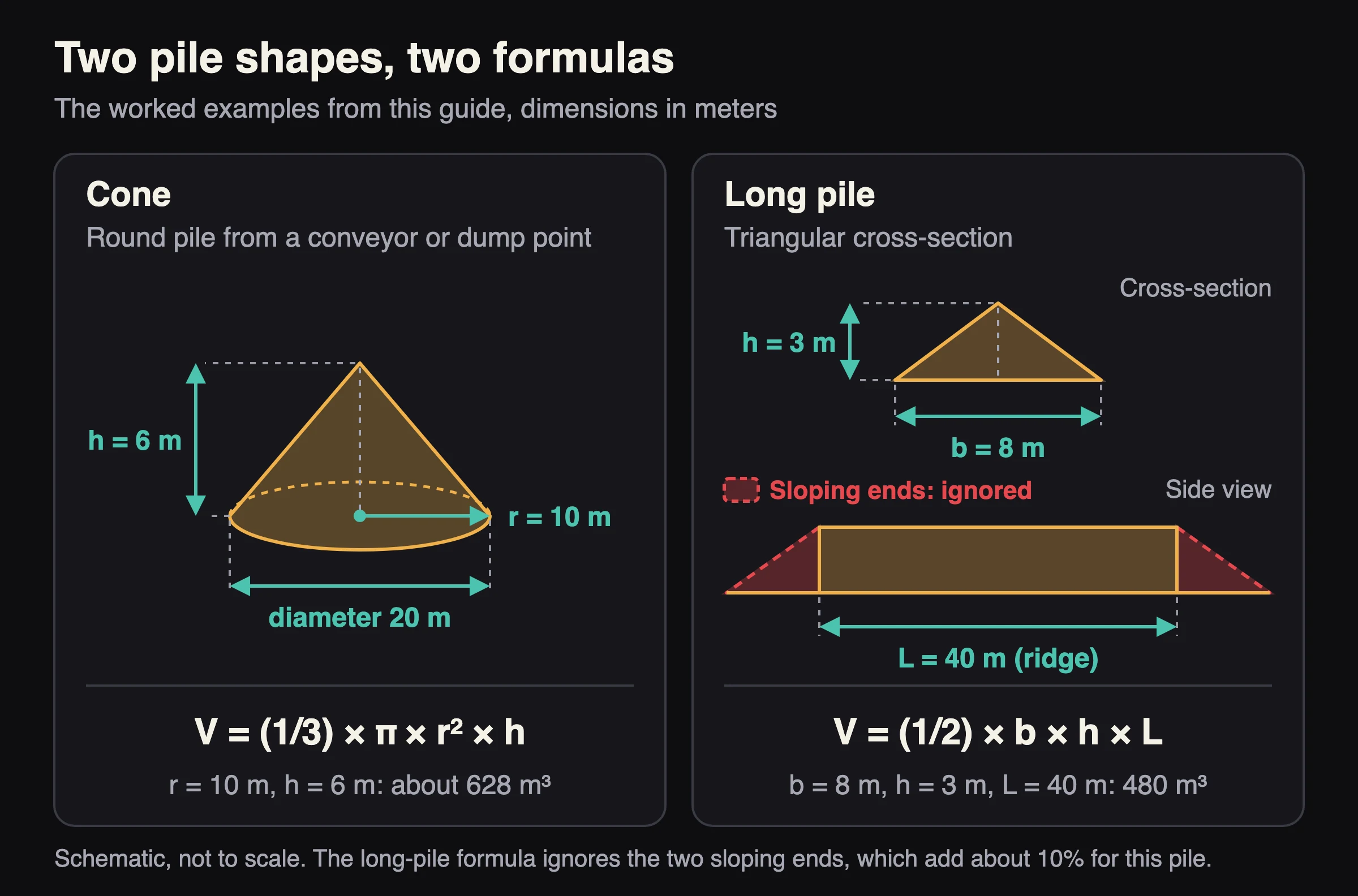
Cone and triangular pile geometry for volume calculation with base, height and length marked
Figure 1: a cone (base diameter 20 m, height 6 m) and a long pile with a triangular cross-section (8 m wide, 3 m high, ridge 40 m long), with their volume formulas.

Cone (a round pile from a conveyor or a dump point)

Volume = (1/3) × π × r² × h, where r is the base radius (half the diameter) and h is the height.

Example: a pile with a base diameter of 20 m and a height of 6 m. The radius is 10 m. Volume = (1/3) × 3.1416 × 10² × 6 = about 628 m³.

Long pile with a triangular cross-section

Volume = (1/2) × b × h × L, where b is the base width, h the height and L the length of the ridge, measured where the cross-section stays the same. This ignores the two sloping ends. If the ends slope like the sides, they add about the volume of one cone with the same base width and height, which is about 50 m³ (10%) for the example below, so the formula understates the volume of a short pile noticeably.

Example: a pile 8 m wide at the base and 3 m high, with a ridge 40 m long. Volume = 0.5 × 8 × 3 × 40 = 480 m³, not counting the two end slopes.

Flat-topped pile (truncated cone)

Volume = (1/3) × π × h × (R² + R × r + r²), where R is the base radius, r is the radius of the flat top and h is the height.

Example: base diameter 20 m, top diameter 6 m, height 5 m. Volume = (1/3) × 3.1416 × 5 × (10² + 10 × 3 + 3²) = about 728 m³.

Irregular piles: the prismoidal method

For irregular piles, surveyors divide the pile into sections and apply the prismoidal formula, volume = L/6 × (A1 + 4 × Am + A2), where A1 and A2 are the end areas, Am is the middle area and L is the section length. A 2022 study of a Malawi quarry used geometric (prismoidal) formulas with tape measurements and came within 1.3% of the reference volume of 265.4 m³ on one pile (source). The reference volume was supplied by the quarry’s mill operator. The tape survey needed at least four people and took 97 minutes.

Step 2: Convert Volume to Weight

Weight = volume × bulk density. Bulk density is the mass of the loose material per unit of volume, including the air between particles. It is not the same as the density of the solid material, and it changes with particle size, compaction and moisture.

Example in metric units: the 628 m³ cone of dry sand at 1.6 metric tons per cubic meter (t/m³), the top of the listed dry range, is about 1,005 metric tons. The same pile with wet sand at 1.92 t/m³ is about 1,206 metric tons, about 20% more. That is a large step taken from the table’s wet sand row. The extra weight at a few percent moisture is much smaller, so measure the moisture content of your own pile.

Example in US units: tons = cubic yards × density in lb/ft³ × 27 ÷ 2,000. For 1,000 yd³ of dry sand at 90 lb/ft³: 1,000 × 90 × 27 ÷ 2,000 = 1,215 short tons (a short ton is 2,000 lb).

Bulk Density Table for Common Materials

These values are typical bulk densities from The Engineering ToolBox, converted from lb/ft³. The source notes that bulk density differs from the solid material density and recommends checking values against other sources before important calculations. Treat the table as a starting point, and measure your own material.

MaterialBulk density, lb/ft³Bulk density, metric tons/m³
Sand, dry80 to 1001.28 to 1.60
Sand, wet1201.92
Gravel75 to 851.20 to 1.36
Crushed rock1342.15
Limestone, crushed85 to 951.36 to 1.52
Coal, lump45 to 550.72 to 0.88
Coal, ground400.64
Salt, granulated70 to 801.12 to 1.28
Salt, coarse crushed45 to 550.72 to 0.88
Cement powder, portland85 to 951.36 to 1.52
Wood chips20 to 300.32 to 0.48
Iron ore1502.40
Wheat, whole kernel45 to 550.72 to 0.88
Phosphate fertilizer600.96

Calculator

Enter the dimensions and the density to get an estimate of volume and tonnage.

Stockpile Volume and Tonnage Calculator

An estimate from simple geometry. For the long pile, enter the length of the ridge without the end slopes. The two end slopes are not included and can add roughly 10% on a short pile like the example. For a flat-topped pile, use the truncated cone formula above. Use a dot or a comma as the decimal mark, without thousands separators.

Choosing a material fills in the middle of its listed density range (for dry sand 1.44 t/m³, while the worked example above uses the top of the range, 1.60 t/m³), so the totals differ. Change the density field to use a density measured on your own material.

Why Real Piles Are Harder Than the Formulas

  • The base surface. Volume is measured against a reference surface under the pile. If the ground is sloped, or the pile touches a wall or another pile, a flat base gives the wrong answer. Even the choice of base plane, such as the lowest point or a mean plane, changes the result.
  • Irregular shape. Cones and ridges are idealizations. Real piles have peaks, valleys and hidden faces.
  • Density changes. Moisture, compaction and particle size move the density. A pile that is wet on the outside and dry inside has no single density.
  • Edges and toe. The toe of the pile is hard to define and often hidden by spilled material.

How LiDAR and Drones Calculate Volume

A 3D LiDAR sensor or a drone photogrammetry model builds a surface of the pile as a grid. For each cell, the software takes the height of the pile above the base surface, multiplies it by the cell area, and adds up all the cells: volume = sum of (height above base × cell area). This handles irregular shapes and does not depend on an idealized cone. Accuracy then depends on coverage, calibration and the base surface.

CRATUS fixed systems, such as the VMS-HS128 and VMS-HS096, monitor the pile continuously and calculate volume directly from the 3D model. Weight comes from a density model characterized for your material, with a confidence interval, as explained in LiDAR weight estimation. For trucks and conveyors, see conveyor volume measurement.

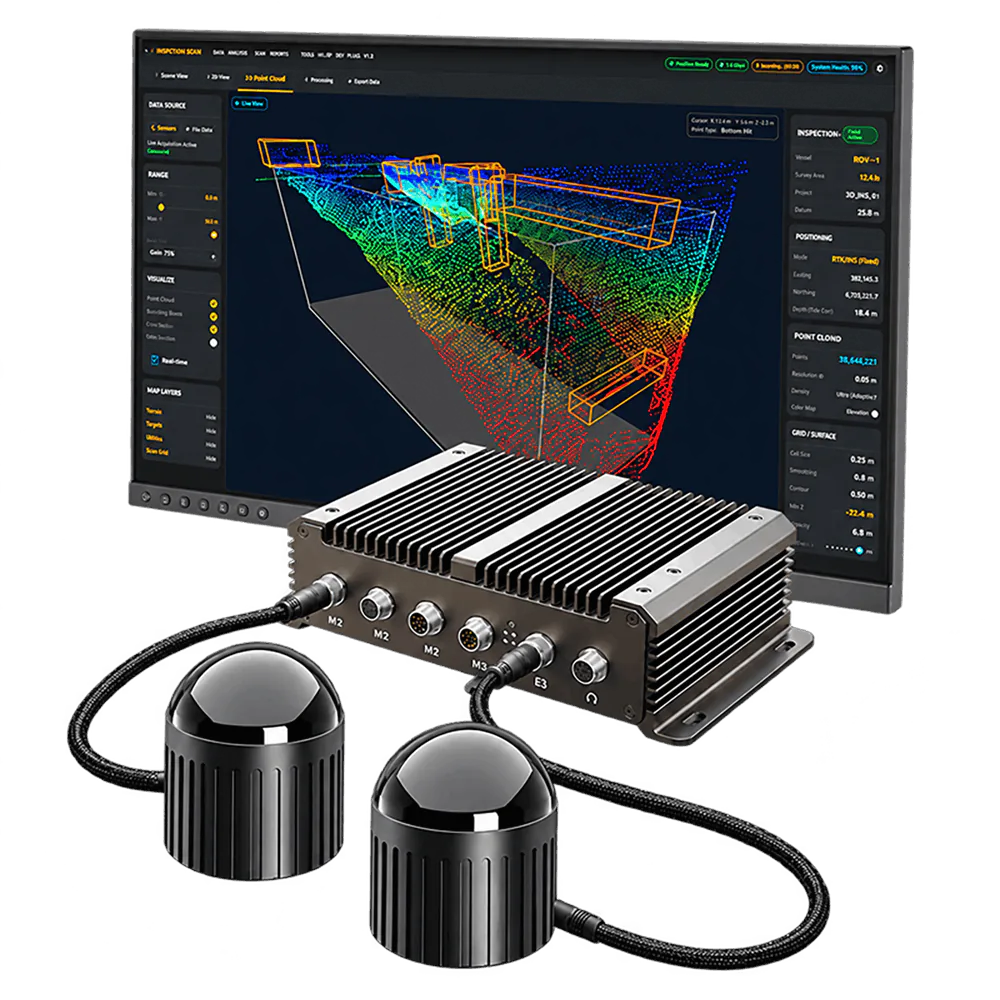
CRATUS VMS-HS128 volume measurement system with two dome LiDAR sensors, an edge unit and a monitor showing a 3D point cloud
CRATUS VMS-HS128, for bunkers, domes and warehouses
CRATUS VMS-HS096 volume measurement system with two dome LiDAR sensors, an edge unit and a monitor showing a 3D point cloud
CRATUS VMS-HS096, for bunkers, domes and warehouses

A Short Checklist for Reliable Tonnage

  1. Define the base surface and keep it the same each time.
  2. Measure the volume with a method suited to the pile shape, and check it against a second method now and then.
  3. Use a bulk density measured on your material, not only a table value.
  4. Record moisture, and decide whether you report wet or dry tons.
  5. State the uncertainty, not only the number.

If you need a number every day instead of every quarter, see how continuous stockpile measurement works.

Frequently Asked Questions

How do you calculate the volume of a conical stockpile?

Volume equals one third of pi times the radius squared times the height. For a base diameter of 20 m and a height of 6 m, the volume is about 628 m³.

How do you convert cubic yards of material to tons?

Multiply cubic yards by the bulk density in lb/ft³, multiply by 27 and divide by 2,000 to get short tons. For 1,000 yd³ of dry sand at 90 lb/ft³ that is about 1,215 short tons.

What density should I use for my material?

Use a bulk density measured on your own material when you can. Tables give typical ranges, for example dry sand at 80 to 100 lb/ft³ (1.28 to 1.60 metric tons per m³), but particle size, compaction and moisture move the value.

How does moisture change the weight of a stockpile?

Moisture adds water weight and usually raises the bulk density. In the same table, wet sand is listed at 120 lb/ft³ against 80 to 100 lb/ft³ for dry sand. Decide whether you report wet tons or dry tons, and record the moisture content.

How accurate are manual stockpile volume formulas?

It depends on the pile. In one quarry test on one pile, a tape and prismoidal survey came within 1.3% of the reference volume supplied by the quarry. The simple cone and ridge formulas can be off by more, for example about 10% on the 40 m long pile above because they ignore the ends, and accuracy falls when the pile is irregular or the base surface is uncertain.

How does LiDAR calculate stockpile volume?

It builds a 3D surface of the pile, takes the height of each grid cell above the base surface, multiplies by the cell area and adds the cells up. Weight is then volume times a density model for the material.

What is the base surface in a stockpile volume calculation?

It is the reference surface under the pile that volume is measured against, usually the ground or floor. A wrong base surface is a common source of error, especially on sloped ground or when piles touch.

Zeki Gunay, founder and CEO of CRATUS Technology, Inc.
Written by
Founder and CEO, CRATUS Technology, Inc.

Zeki founded CRATUS in 2013 and leads the San Jose team building LiDAR volume measurement systems, IoT sensing platforms, and energy and industrial automation hardware.

Full profileLinkedIn

Interested ?

We would be pleased to send you detailed information about our products or services.
Simply enter your details in the contact form below and we will get in touch with shortly.

CRATUS respects your personal information and keeps it safe. By sending this form, you consent to allow CRATUS to store and process your personal information as stated in our Privacy Policy.

GET IN TOUCH

One of our experts will be communicating with you shortly. We are committed to understanding your application and providing support, tailored to your specific requirements.